Home/Module IV

The Book of 1 Samuel · 31 Chapters

Israel Demands a King

A barren woman's prayer. A boy who hears God in the dark. A nation that wants to look like everyone else, and gets exactly what it asks for. Behind it all, the question that decides everything: what kind of king does Israel actually need?

I · The Bridge

From judges to kings

Standing in the gap between the chaos of the judges and the throne of David is one towering figure: Samuel. He is the last of the judges and the first of the great prophets, the only man in Scripture who anoints not one king but two. When the book opens, Israel is leaderless and adrift, the priesthood is corrupt, and "the word of the Lord was rare in those days; there was no frequent vision" (3:1). When it closes, a king sits on a throne, a shepherd waits in the wings with oil already drying on his head, and the whole shape of Israel's future has been set. Everything turns on the choices made in these thirty-one chapters.

The book asks one big question, and asks it in several forms: what kind of king does Israel really need? The people answer first, and they answer badly. They want a king "like all the nations," tall and impressive and able to fight their battles, so they can stop depending on a God they cannot see. They get exactly that in Saul, and it nearly destroys them. Then God answers, and His choice could not be more different: the overlooked youngest son of an ordinary family, a boy with a harp and a sling and a heart that actually belongs to God. The whole second half of the book is the slow-motion fall of the first king and the patient, hunted rise of the second.

And the deepest answer to the question is not given in the book at all. Saul fails. David, for all his greatness, will fail too. The kind of king Israel needs, the King this book is teaching you to long for, is one who looks like David's God and rules like David's heart but never falls. He doesn't arrive until the New Testament, born in David's town, hailed as the Son of David. First Samuel is, in the end, an extended ache for Him.

Timeframe
Roughly 1100–1010 BC, from Samuel's birth to the death of Saul.
Big idea
Trusting God's kingship; learning that He weighs the heart, not the outward appearance.
The turning point
Chapter 8, the demand for a king "like all the nations," which God grants as both gift and judgment.
Key verse
"To obey is better than sacrifice, and to listen than the fat of rams." (15:22)

II · Walking Through the Book

The events of 1 Samuel

1 Samuel 1–2

Hannah's prayer, and a song that echoes for centuries

The whole monarchy begins not with a battle but with a broken woman praying so hard the priest assumes she's drunk. Hannah is barren, mocked by her rival, and she pours out her soul to God, vowing that if He gives her a son she will give the son back to Him. God answers; she names him Samuel and, weaned, hands him over to serve at the tabernacle. Then she sings (2:1–10), and her song is astonishing: a hymn about a God who topples the proud and lifts the lowly, who reverses every expectation. A thousand years later a young woman named Mary, told she will carry the King, will sing almost the same song (Luke 1:46–55). The book opens by telling you which way God's universe tilts: toward the humble.

1 Samuel 2–3

A corrupt priesthood and a boy who listens

Eli's sons, Hophni and Phinehas, are called "worthless men" who treat the offerings of God with contempt and prey on the worshipers. Against that rotting backdrop, the boy Samuel hears his name called in the night and finally answers, "Speak, for your servant hears" (3:10). The contrast is the point: the men who should hear God are deaf, and God speaks instead to a child who will listen. A new voice arrives precisely as the old order collapses under its own corruption.

1 Samuel 4–6

The ark captured, and the glory departed

Israel drags the ark of the covenant into battle like a lucky charm, treating God as a weapon they can aim. They are routed, the ark is captured, Eli's sons die, and old Eli topples backward and dies at the news. A dying mother names her newborn Ichabod, "the glory has departed." But God is no one's trophy. Among the Philistines, the idol Dagon keeps falling face-down before the ark, plagues break out, and the terrified enemy ships it back. The lesson cuts both ways: God will not be used by His people, and He will not be held by His enemies. He defends His own glory.

1 Samuel 7

Ebenezer: thus far the Lord has helped

Samuel, now leading, gathers the nation at Mizpah and calls them to throw away their idols. When the Philistines attack, God thunders against them, and Israel wins without really fighting. Samuel sets up a stone and names it Ebenezer, "stone of help," saying, "Till now the Lord has helped us." It is the high-water mark of the old way, with God Himself as Israel's only king, and it is the last calm moment before everything changes.

1 Samuel 8–10

"Give us a king"

The elders come to the aging Samuel and demand a king "like all the nations." Samuel is wounded; God tells him the deeper truth: "they have not rejected you, but they have rejected me from being king over them" (8:7). God grants the request and, through Samuel, spells out exactly what a king will cost them in sons, daughters, fields, and freedom. Saul, a head taller than anyone else, is anointed in private and then chosen in public, where they find him hiding among the baggage. The man they wanted looks every inch a king, and is already afraid.

1 Samuel 11–12

A promising start

Saul begins genuinely well. When Jabesh-gilead is threatened, the Spirit of God rushes on him, he rallies Israel, and wins a great victory, then refuses to take revenge on those who had doubted him. The kingdom is renewed at Gilgal. Samuel gives a farewell address, warning king and people alike that their only real safety, monarchy or no monarchy, is to fear and serve the Lord with all their heart.

1 Samuel 13–15

The unraveling of Saul

Twice Saul fails a test of obedience, and both times the failure looks small, which is the whole point. At Gilgal he grows impatient waiting for Samuel and offers the sacrifice himself, a thing not his to do. Then, told to devote the Amalekites and their plunder entirely to destruction, he spares the king and the best livestock and blames the people, then tries to dress it up as worship. Samuel's reply is one of the great lines of Scripture: "To obey is better than sacrifice" (15:22). God was never testing Saul's competence. He was testing whether Saul would be a king under the King, and Saul kept treating God's commands as suggestions he could improve. The throne is torn from him.

1 Samuel 16

God chooses a shepherd

Samuel is sent to Bethlehem to anoint a new king from Jesse's sons. One by one the tall, impressive older brothers pass by, and God declines them all with the verse at the heart of the book: "The Lord sees not as man sees: man looks on the outward appearance, but the Lord looks on the heart" (16:7). The youngest, David, is out with the sheep and has to be sent for. He is anointed, and the Spirit rushes on him. Then, in a stroke of irony only the writer can see coming, this future king is brought into Saul's court to soothe the tormented old king with his harp.

1 Samuel 17

David and Goliath

In the Valley of Elah, a nine-foot Philistine champion taunts the armies of Israel for forty days while grown soldiers tremble. A shepherd boy delivering bread to his brothers hears the blasphemy and is genuinely offended that no one will answer it. Refusing armor, he takes five smooth stones and runs toward the giant, shouting that "the battle is the Lord's" (17:47). One stone, and the giant falls. Read it again and notice the shape of it: a people who cannot save themselves, paralyzed by an enemy they cannot beat, rescued by an unlikely champion who fights in their place and wins the victory they then get to share. The story is doing more than teaching bravery.

1 Samuel 18–20

Jealousy, and a friendship that gave everything away

The women sing that Saul has struck down thousands and David tens of thousands, and from that day Saul watches David with a suspicion that curdles into murderous rage, hurling a spear at him more than once. Against that hatred shines one of the Bible's great friendships. Jonathan, Saul's own son and rightful heir, loves David "as his own soul" and binds himself to him by covenant, knowing full well that David's rise means his own throne is gone. He gives it up gladly. It is the rarest kind of love: the kind that lets go of its own claim for the sake of God's chosen one.

1 Samuel 21–26

David the fugitive, and the throne he wouldn't grab

David spends years on the run, hunted across the wilderness, gathering a band of the desperate and the indebted at the cave of Adullam. Twice Saul falls completely into his hands, once in a cave at En-gedi and once asleep in his own camp, and twice David refuses to lift a finger against "the Lord's anointed," choosing to wait for God's timing rather than seize the crown by force. He already has the anointing; he will not take the throne by murder. It is the discipline that defines him: a man who trusts God enough to wait.

1 Samuel 28, 31

Saul's last night, and last day

On the eve of his final battle, abandoned by the God he stopped obeying, Saul does the very thing he once outlawed and consults a medium at Endor to summon Samuel, who only confirms his doom. The next day, on the slopes of Mount Gilboa, the Philistines overwhelm Israel. Jonathan is killed, and Saul, gravely wounded, falls on his own sword. The first king's story ends in the dark, by his own hand, while the man already anointed waits in exile for a throne he would not take by blood.
III · The Turning Point

"A king like all the nations"

The request for a king in chapter 8 is the pivot of the entire book, and it is more tangled than it first appears. God had always planned for Israel to have a king one day. The law of Moses anticipated it and even legislated for it (Deuteronomy 17:14–20), and the dying Jacob had promised the scepter to the tribe of Judah. So the problem was never the what. It was the why, and the when, and the kind of king they had in mind.

7Obey the voice of the people in all that they say to you, for they have not rejected you, but they have rejected me from being king over them. 1 Samuel 8:7

Israel wanted a king for all the wrong reasons: to be like everyone else, and to have a visible man to follow instead of an invisible God. They wanted to trade the risk of faith for the comfort of looking normal among the nations. So God, in one of the most sobering acts of judgment in Scripture, gave them exactly what they asked for. Saul is the king the people would have designed for themselves: tall, strong, impressive, the obvious pick. He is also a warning that some of God's hardest judgments come not when He denies our requests but when He grants them. Be careful what you demand to be "like everyone else."

Going Deeper · Why obedience in small things

Saul's two fatal failures (chapters 13 and 15) seem almost trivial, an early sacrifice, some spared sheep, and that is precisely why they are so revealing. God was not grading Saul's military record. He was testing whether this king would actually submit to the King above him, in the small commands where no one was watching and obedience cost him something. A leader who treats God's clear word as negotiable in private will betray it in public, eventually, every time. "To obey is better than sacrifice" is not a footnote about ritual. It is the standard every leader in the Bible is finally weighed against, including the kings yet to come.

IV · A Study in Contrast

Saul and David

The book sets the two kings side by side on purpose. The difference is not talent, and it is not even a perfect obedience, since both men sinned grievously. The difference is the heart underneath, and what each man did the moment he was caught.

King Saul

Chosen byThe people's demand
TribeBenjamin
First impressionTall, handsome, the obvious pick
When confrontedExcused himself, blamed others, clung to the crown
Toward GodUsed Him; obeyed when convenient
EndRejected; died on Mount Gilboa

David

Chosen byGod's own selection
TribeJudah (the royal line)
First impressionOverlooked youngest, out with the sheep
When confrontedBroke, repented, owned his sin (seen fully in 2 Samuel)
Toward GodSought Him; waited rather than seize the throne
EndAn everlasting covenant and throne

"The Lord has sought out a man after his own heart" (13:14). That phrase does not mean David was sinless; the next book makes painfully sure you know he wasn't. It means his heart kept turning back to God. When David finally fell, he broke; when Saul was caught, he managed the optics. The throne went, in the end, to the one who knew how to repent.

V · Going Deeper

Three truths to carry out the door

God sees what no one else can

"Man looks on the outward appearance, but the Lord looks on the heart." That single verse (16:7) is both the most comforting and the most exposing line in the book. Comforting, because it means God is not fooled by your unimpressive résumé, your ordinary face, your lack of platform; He sees a heart that loves Him and counts it as the only credential that finally matters. Exposing, because it means He is also not fooled by your polished surface, your reputation, your Sunday best; He sees straight past all of it to what is actually there. The same God whose sight saves Saul from mattering too much will not let any of us hide. We are known all the way down, and still chosen. That is the gospel in one verse.

A champion who fights in your place

We have shrunk David and Goliath into a children's story about facing your fears, and missed what the chapter is shouting. Israel cannot win this fight; the whole army is helpless before a single overwhelming enemy. So one chosen representative goes out alone, in the name of the Lord, defeats the enemy his people could never beat, and wins a victory they then share simply by belonging to him. That is not first a lesson about your courage. It is a picture of your Savior. Where you stand frozen before sin and death, a greater Son of David went out alone, in your place, and won. The right response to Goliath is not "go be brave." It is "look at the Champion who already fought for you."

The hardest faith is the faith that waits

David is anointed king in chapter 16 and does not actually sit on the throne until the next book, years and years later, after running for his life through caves and wilderness. Twice he could have ended it all with one thrust of a spear into a sleeping Saul, and twice he refused, because the throne taken by murder would not be the throne given by God. There is a particular kind of faith on display there, and it is rarer than the storming-the-giant kind. It is the faith that already has the promise and still waits, that refuses to grab with its own hand what God has said He will give in His own time. Most of us find Goliath easier than the cave. The cave is where David was really made.

The World of Samuel and Saul

Where it all happened

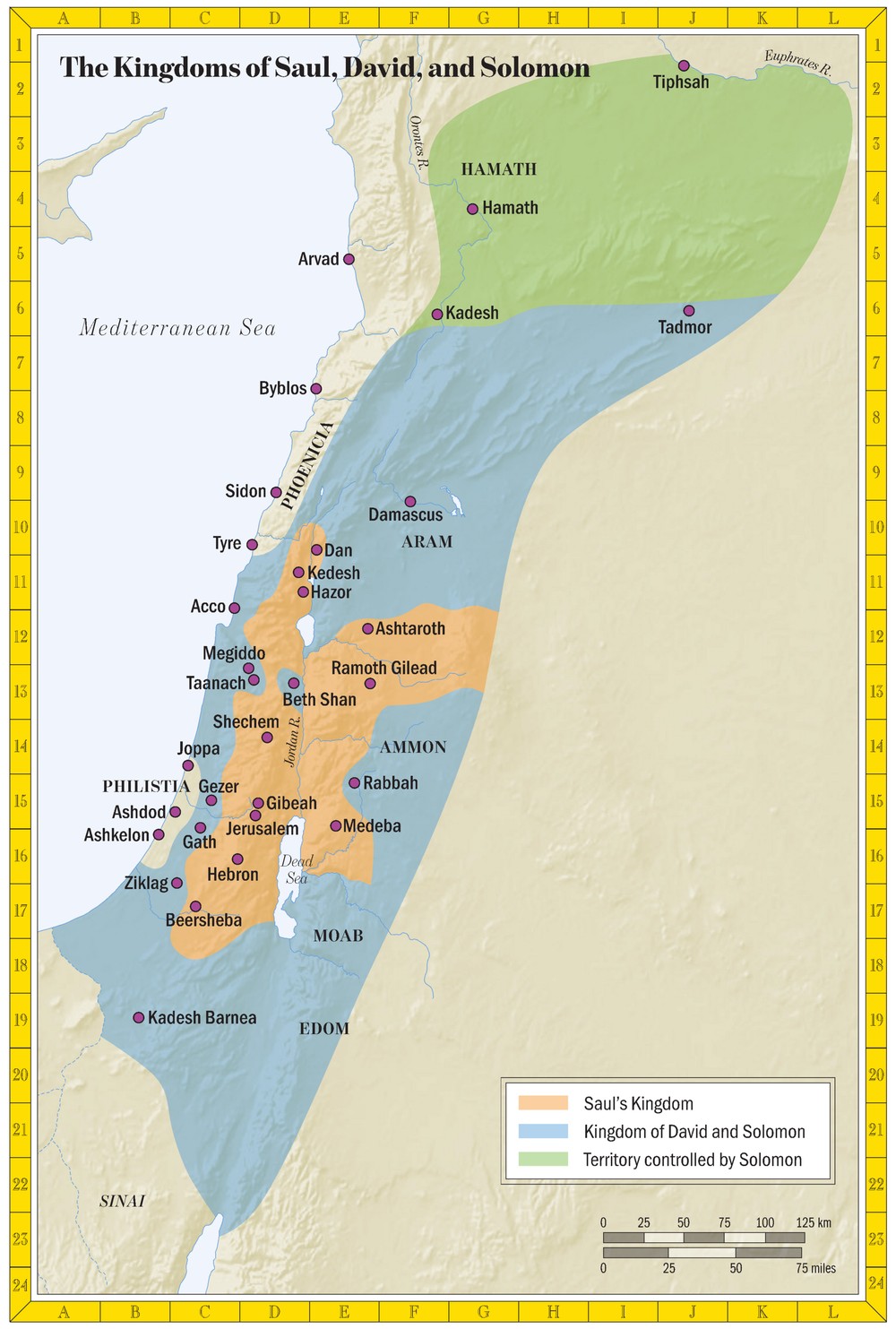
From Samuel's home at Ramah to the fatal slopes of Gilboa, the story plays out across a small, crowded landscape. The map shows Saul's kingdom (shaded orange); the table locates the key events. Click the map to enlarge it.

Map of the kingdom of Saul, later expanded under David and Solomon

Map: Biblica, Inc. — “Open Bible Maps,” CC BY-SA 4.0

Saul's kingdom is shaded orange. It would expand greatly under David and Solomon (blue and green) in the next book.
The key places in 1 Samuel, north to south.
PlaceWhat happened there
Mount GilboaSaul and Jonathan fall in their final battle (ch 31).
EndorSaul consults a medium on his last desperate night (ch 28).
Jabesh-gileadSaul's first victory rescues this town (ch 11).
ShilohThe tabernacle; Hannah's vow and young Samuel's calling.
RamahSamuel's home and base of ministry.
MizpahThe Ebenezer victory; Saul presented as king (ch 7, 10).
GibeahSaul's hometown and royal capital.
BethlehemDavid anointed by Samuel (ch 16).
Valley of ElahDavid defeats Goliath (ch 17).
En-gediDavid spares Saul's life in the cave (ch 24).
ZiklagDavid's base in Philistine territory.

People to Know

Four lives in 1 Samuel

Hannah
The praying mother
  • StruggleBarrenness
  • VowGave her son back
  • SonSamuel
  • LegacyA song of reversal

"For this child I prayed, and the LORD has granted me my petition."1 Samuel 1:27

Lesson: Honest, desperate prayer moves the heart of God. Hannah's private grief became the doorway to a prophet and a kingdom.

Samuel
Prophet & kingmaker
  • RolesJudge, priest, prophet
  • Heard GodAs a boy
  • AnointedSaul & David
  • Marked byIntegrity

"Speak, for your servant hears."1 Samuel 3:10

Lesson: A listening heart is the start of a faithful life. Samuel led a nation because he first learned, as a child, to hear God.

Saul
The people's king
  • TribeBenjamin
  • AssetTall, impressive
  • FlawFear; disobedience
  • EndRejected

"I have sinned… because I feared the people and obeyed their voice."1 Samuel 15:24

Lesson: Looking the part is not the same as having the heart. Saul feared people more than God, and it slowly cost him everything.

Jonathan
The selfless friend
  • FatherKing Saul
  • WasThe heir
  • ChoseTo protect David
  • BondCovenant friendship

"He loved him as he loved his own soul."1 Samuel 18:1

Lesson: Jonathan surrendered his own claim to the throne for the friend God had chosen. The truest love lets go of rivalry.

For Discussion & Reflection

Study questions

Talk it through

  1. Israel wanted a king to be "like all the nations." Where does the church today reach for worldly forms of strength or security instead of trusting an unseen God? Discuss
  2. Sometimes God's judgment is to give us exactly what we demand. Have you seen that in your life or others'? How does it change the way you pray? Discuss
  3. "The Lord looks on the heart." Talk about how that truth both comforts you and unsettles you. Discuss
  4. David already had the anointing but waited years for the throne, twice refusing to take it by force. How do you tell the difference between faith that waits and passivity that won't act? Discuss

Reflect quietly

  1. Hannah turned her deepest pain into prayer instead of bitterness. What grief are you carrying that you need to actually pour out to God rather than hold alone? Reflect
  2. Saul managed his image; David, when he finally fell, broke and confessed. When you're caught in something wrong, which instinct rises first in you, the cover-up or the confession? Reflect
  3. "Speak, for your servant hears." Are you living in a posture that genuinely expects to hear from God, or only to be heard by Him? Reflect
⚑ Leader Note

It is tempting to make Saul a cartoon villain and David a flawless hero, and 1 Samuel resists both. Saul starts humble and genuinely gifted; David's worst chapters are still ahead of him in 2 Samuel. Keep the group's focus on the heart, not the highlight reel. Chapter 8 is the richest discussion in the book and worth lingering on; many people have never noticed that God grants a sinful request as a judgment. If your group enjoys it, read Hannah's song (2:1–10) and Mary's Magnificat (Luke 1:46–55) side by side and let them feel the echo across a thousand years.

Next in the Series

Module V · The Book of 2 Samuel

The crown is finally David's. A new capital, an everlasting promise, a grievous fall, and a long road of grace. The story reaches the king after God's own heart, and points past him to a greater King still.