Home/Module II

The Book of Judges · 21 Chapters

The Downward Spiral

One generation crossed the Jordan on dry ground. Their grandchildren worshiped the gods of the people they were sent to drive out. Judges is the unflinching story of how fast a people can forget, and how stubbornly God refuses to let them go.

I · The Forgetting

How a nation comes apart

There is a single verse near the front of the book that explains everything that follows, and it is worth slowing down over. After Joshua and his whole generation had died, "there arose another generation after them who did not know the Lord or the work that he had done for Israel" (2:10). Not a generation that rebelled outright. A generation that simply did not know. The stories had stopped being told around the fire. The stones at Gilgal had become just stones. And a people who forget what God has done will always, eventually, start worshiping something else.

That is the engine of Judges. The book spans roughly three centuries, from the death of Joshua to the eve of the monarchy, and it is not a tidy history. It loops. Israel sins, suffers, cries out, and is rescued, then turns around and does it all again. The author steps out from behind the curtain in chapter 2 and tells you plainly that this is the pattern (2:11–19), so that by the time you watch it grind through Othniel, Deborah, Gideon, and the rest, you already know how each story ends. The tragedy is not that you can't see it coming. It's that they couldn't.

And here is the bitter irony the book wants you to feel. Israel was sent into Canaan to be different, a holy people displacing a corrupt one. Instead, Canaan moves into Israel. They intermarry, adopt the local gods, and adopt the local cruelty, until by the final chapters God's people are behaving exactly like the nation they were supposed to replace. Judges is a mirror, and the face in it is uncomfortably familiar. It is the story of what we become when we are left to ourselves.

Two sentences frame the whole book like bookends, appearing first in chapter 17 and again as its very last verse:

In those days there was no king in Israel. Everyone did what was right in his own eyes.

Judges 21:25

Read it one way and it sounds like freedom. Read it the way the author means it and it is a verdict. With no king to lead them, and no shared submission to the King of heaven, "right in his own eyes" became the only standard left, and the book ends in idolatry, abduction, and civil war. Judges is doing something deliberate to you. It is making you homesick for a king who has not yet come.

Timeframe
Roughly 1375–1050 BC, from Joshua's death to Samuel and the first king.
Structure
A repeating cycle of decline (ch 3–16), framed by a prologue (1–2) and a dark double epilogue (17–21).
"Judge"
Not a courtroom official but a deliverer God raised up to rescue and lead Israel for a season.
Big idea
The faithfulness of God meeting the faithlessness of His people, and the growing ache for a true King.
II · The Engine of the Book

The cycle of the judges

The same five stages turn through nearly every chapter. Click each stage on the wheel to read what it looked like and where Scripture describes it.

The Spiral each turn lower 1 Rebellion 2 Retribution 3 Repentance 4 Rescue 5 Rest
Stage One

Rebellion

"The people of Israel did what was evil in the sight of the Lord and served the Baals" (2:11). After every season of peace, a new generation drifted to the gods of the land. The root sin was not dramatic; it was forgetting. They stopped telling the story, and a people who lose the memory of grace will always reach for another god to fill the silence.

★ It's a spiral, not a circle

The stages repeat, but the nation does not return to where it started. Each turn sinks lower: the judges grow more flawed, the deliverances messier, the people more broken, until the book ends in horrors no foreign army inflicted. A staircase spiraling down is a truer picture than a wheel. And every step asks the same unanswered question: who will finally break this thing?

III · The Whole Roster

The twelve judges at a glance

Six judges get full stories (the "major" judges); six are named in just a verse or two (the "minor" judges). One man, Abimelech, seized power and was no deliverer at all. Years are as the text gives them.

Judges in the order they appear (Judges 3–16).
JudgeTribe / RegionOppressorOppressionPeace / TermReference
OthnielJudahAram (Cushan-rishathaim)8 yrs40 yrsJudg 3:7–11
EhudBenjaminMoab (Eglon)18 yrs80 yrsJudg 3:12–30
ShamgarunknownPhilistinesJudg 3:31
Deborah & BarakEphraim / NaphtaliCanaan (Jabin & Sisera)20 yrs40 yrsJudg 4–5
GideonManassehMidian7 yrs40 yrsJudg 6–8
AbimelechManasseh (Shechem)self-appointed king3 yrsJudg 9
TolaIssachar23 yrsJudg 10:1–2
JairGilead22 yrsJudg 10:3–5
JephthahGileadAmmon18 yrs6 yrsJudg 10:6–12:7
IbzanBethlehem7 yrsJudg 12:8–10
ElonZebulun10 yrsJudg 12:11–12
AbdonEphraim8 yrsJudg 12:13–15
SamsonDanPhilistines40 yrs20 yrsJudg 13–16
★ A pattern hiding in the list

Read the judges in order and you notice the line is sloping down. Othniel, the first, has no recorded flaw. By the middle, Gideon ends his life making an idol. By the end, Jephthah sacrifices his daughter and Samson can't keep a single vow. The deliverers are getting worse, not better, and the gaps of peace are shrinking. The author is doing this on purpose. He is exhausting the possibilities of human leadership so that, by the last page, you are ready to admit that Israel does not need a better judge. It needs a different kind of king altogether.

IV · The Breakdown

Each judge, up close

Open any judge to read the story, the strategy, and the flaw the writer wants you to notice.

Caleb's younger kinsman, and the only judge from Judah. His account is short and clean, almost a template: Israel sins, Aram oppresses, the people cry out, the Spirit of the Lord rushes on Othniel, and the land rests forty years. He is the one judge with no recorded flaw, and he is placed first on purpose. He is the measuring stick. Everything that comes after is graded against how far it falls from this simple, Spirit-empowered faithfulness.

A left-handed man from Benjamin, a tribe whose name means "son of the right hand," so the story opens with a quiet joke. Ehud hides a homemade double-edged sword on his right thigh, where no guard would think to search, gains a private audience with the obese Moabite king Eglon, and kills him. The grisly, almost slapstick detail underlines a serious point that runs through the whole book: God delights to work through the overlooked, the disqualified, the man nobody would pick. Eighty years of peace followed, the longest rest in Judges.

One verse, one weapon, six hundred Philistines. Shamgar struck them down with an oxgoad, a long wooden farm tool for prodding cattle. He has no genealogy, no recorded term, just a single act of courage with whatever happened to be in his hand. Sometimes faithfulness is nothing more spiritual than refusing to wait for a better weapon before you obey.

Deborah is a prophetess and the only judge who actually judges in the legal sense, settling disputes under her palm tree. When she summons Barak to face Sisera's nine hundred iron chariots, he will only go if she comes with him, so she tells him the glory of the victory will go to a woman instead. It does, twice over: to Deborah who led when the men hesitated, and to Jael, who drove a tent peg through the sleeping Sisera's skull. Chapter 5 preserves their victory song, one of the oldest poems in the Bible. The whole episode is a gentle, pointed rebuke to a generation of men who would not step up.

Found threshing wheat down in a winepress to hide it from the Midianites, Gideon is greeted by the angel as "mighty man of valor," which reads as gentle irony given where he is cowering. He asks for sign after sign, the famous fleece laid out twice, before God deliberately whittles his army from thirty-two thousand down to three hundred, "lest Israel boast… saying, 'My own hand has saved me'" (7:2). The night raid with trumpets and torches is a masterpiece of faith. And then it curdles. Gideon collects the gold of victory and makes an ephod, "and all Israel whored after it there, and it became a snare to Gideon and to his family" (8:27). Even the book's most dramatic deliverer plants, with his own hands, the seed of the next rebellion. Success is its own kind of test, and he failed it.

Not a judge but a warning, dropped into the middle of the book. Gideon's son by a concubine murders his seventy half-brothers on a single stone to make himself king of Shechem; only the youngest, Jotham, escapes, to shout down a haunting fable about trees who wanted a king and got a bramble. Three years later the alliance collapses, and Abimelech is mortally wounded when a woman drops a millstone on his head from a tower. He begs his armor-bearer to finish him so no one can say a woman killed him. This is the book's first taste of a self-made king, and it is poison. Israel is not ready for a throne while its heart still belongs to itself.

The son of a prostitute, driven out by his half-brothers, Jephthah becomes a gang leader in the badlands until the very elders who rejected him come crawling back for help against Ammon. He is a shrewd negotiator and a genuine deliverer, but he makes a reckless bargain: if God gives him victory, he will offer up whatever comes out of his door to meet him. What comes out is his only daughter. The text reports the heartbreak without ever applauding the vow. Jephthah is what happens when zeal runs ahead of knowing who God actually is. The God of Israel had outlawed human sacrifice in horror; He never wanted that vow, and a man who knew Him better would have known it.

Set apart as a Nazirite from the womb and gifted with impossible strength, Samson is the most physically powerful and most morally bankrupt of all the judges, a one-man portrait of Israel itself: blessed beyond reason, chasing foreign women, breaking every vow, presuming on a favor he treats as a magic trick until it quietly departs and "he did not know that the Lord had left him" (16:20). His weakness for Delilah costs him his hair, his strength, and his eyes. Yet the book refuses to end him in the dark. Blind, chained, and mocked in the temple of Dagon, he prays one last honest prayer, and God answers, and he brings the house down on more of the enemy in his death than in his life. Even Israel's most wasted deliverer is not past the reach of grace.

V · Pressure From Every Side

Where the enemies came from

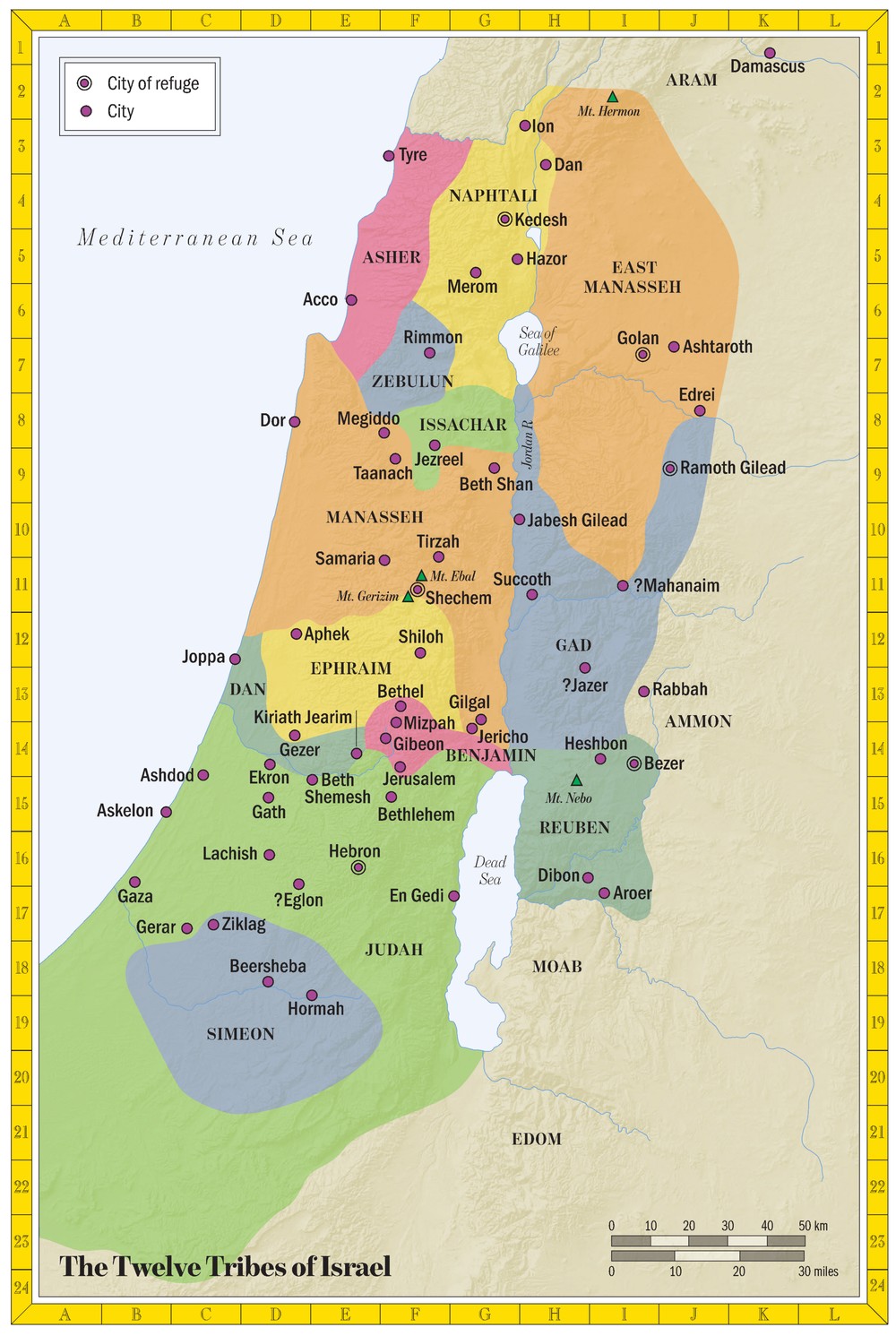
Israel's tribal territories sat ringed by hostile nations — Aram to the northeast, Ammon and Moab across the Jordan, Edom to the south, the Philistines on the coast. The map shows that encirclement; the table below names which oppressor pressed in from where, and which judge God raised to meet them. Click the map to enlarge it.

Map of Israel's tribal territories ringed by the surrounding nations of the judges era

Map: Biblica, Inc. — “Open Bible Maps,” CC BY-SA 4.0

A small nation surrounded. Part of God's stated purpose in leaving these nations was "to test Israel" and to teach a generation with no experience of war (Judges 3:1–2).
Each oppressor pressed in from a different direction, and God raised a deliverer to meet them.
OppressorPressed in fromDeliverer raised up
Aram (Mesopotamia)The far northeastOthniel
MoabThe east, across the JordanEhud
Canaan (Hazor)The northDeborah & Barak
MidianThe eastern desertGideon
AmmonThe east, in GileadJephthah
PhilistiaThe southwest coastShamgar & Samson

VI · Going Deeper

What the spiral is really teaching

Grace you did absolutely nothing to earn

Strip Judges down and it is one of the clearest pictures of grace in the whole Bible, precisely because the people are so unworthy of it. They do not clean themselves up before God rescues them. They do not even, most of the time, seem genuinely sorry; they cry out because they are in pain, and God saves them anyway. Over and over He sends a deliverer to a people who have just betrayed Him, for no reason on their side at all. If you have ever wondered whether God could keep loving someone who keeps failing in the same way, Judges is your answer, and the answer is yes, to a degree that is almost scandalous.

There is no such thing as a little idolatry

Israel rarely abandoned the Lord outright. They added. They kept worshiping Him and worshiped Baal too, hedging their bets, wanting the covenant God and the fertility god both. That is what made it so deadly, because it never felt like apostasy; it felt like prudence. The book insists there is no stable middle. A heart that tries to serve God and an idol does not stay balanced; it slides, every time, toward the idol. Whatever your Baal is, the thing you reach for alongside God when you're afraid, Judges says it will not stay a junior partner. Given a generation, it runs the house.

The hole shaped like a king

By the end you can feel the book straining toward something it cannot reach. It keeps muttering, "there was no king." It keeps producing leaders who rise and rescue and then die or disappoint. The whole structure is engineered to create a longing, an unscratched itch for a leader who would be strong like Gideon without the idolatry, set apart like Samson without the weakness, righteous all the way down, and who would not die. That longing is not answered in Judges. It is barely answered by David, the best king Israel ever got, who turns out to have his own ruinous flaws. It is finally answered only by great David's greater Son, the King who breaks the cycle not by rescuing us from foreign armies but by dealing with the enemy inside, the sin that no judge could ever defeat.

VII · Judges 17–21

How dark it really got

The book does not end with a judge. It ends with two horror stories, and it drops the refrain like a hammer between them: there was no king in Israel. These chapters are placed last on purpose, to show you the floor the nation had fallen to, with no foreign enemy to blame. By now the rot is entirely homegrown.

Micah's idols and the migration of Dan

A man named Micah sets up a private shrine with a hand-made idol and hires a wandering Levite as his personal priest, religion entirely on his own terms and budget. The tribe of Dan, hunting for land, simply steals the idol and the priest as they pass and establishes organized idolatry that lasts for generations. Worship has become a thing you assemble to taste, a god you can carry off if the price is right.

The Levite, the outrage, and civil war

A grim episode at Gibeah, deliberately written to echo the sin of Sodom, leads to the abuse and death of a woman and a war that nearly wipes the tribe of Benjamin off the map. Israel turns its swords on itself. The nation that could not defeat its enemies came within a hair of destroying its own.

It is bleak, and it is bleak on purpose. By the final verse you are meant to be aching for someone to set this right, a true king who will not merely rescue for a season but rule with a heart bent toward God. The very next book in most reading orders is Ruth, a quiet candle of faithfulness lit in this same dark era, and it ends with a name that is the first gray light of dawn: David.

People to Know

Four judges worth remembering

Deborah
Prophetess & judge
  • EnemySisera's chariots
  • AllyBarak; Jael
  • Peace won40 years
  • LegacyA song (Judg 5)

"Does not the LORD go out before you?"Judges 4:14

Lesson: God raises up whoever is willing. Deborah led when the men hung back, and handed every ounce of glory to God.

Gideon
The reluctant warrior
  • TribeManasseh
  • EnemyMidian
  • ArmyJust 300
  • FlawThe golden ephod

"The LORD is with you, O mighty man of valor."Judges 6:12

Lesson: God works through weakness and doubt, but a great victory can rot into idolatry. Finishing well is its own battle.

Jephthah
The outcast deliverer
  • FromGilead
  • EnemyAmmon
  • Rejected byHis brothers
  • TragedyA rash vow

"I have opened my mouth to the LORD, and I cannot take it back."Judges 11:35

Lesson: Zeal without knowledge of God is dangerous. He saves through the rejected, yet warns against bargaining with heaven.

Samson
Strength & ruin
  • TribeDan
  • VowNazirite
  • EnemyPhilistines
  • WeaknessDelilah

"O Lord GOD, please remember me."Judges 16:28

Lesson: Gifting is not godliness. His ruin came from inside, and grace still met him at the very end.

For Discussion & Reflection

Study questions

Talk it through

  1. The whole spiral starts because one generation "did not know the Lord or his works." What does it actually take to hand faith down, and where do you see that transfer breaking today? Discuss
  2. God rescues a people who never really repent, again and again. What does the cycle reveal about His character that we'd miss if we only read the tidy stories? Discuss
  3. Israel's downfall was usually addition, not abandonment: God and Baal. Where does the modern church try to keep both, and why does it never stay balanced? Discuss
  4. The deliverers get worse as the book goes on, building a hunger for a true King. How does that change the way you read the Gideons and Samsons, not as heroes but as signposts? Discuss

Reflect quietly

  1. Is there a cycle in your own life that keeps turning, the same sin, the same regret, the same fresh start? What would it look like to bring the root to God instead of just managing the symptom again? Reflect
  2. Name your Baal, the thing you reach for alongside God when you're afraid or empty. Be honest about whether it's still a junior partner. Reflect
  3. Gideon's gift became an idol; Samson's strength outran his character. Where might your strengths be quietly outpacing your walk with God? Reflect
⚑ Leader Note

Two traps with Judges. The first is turning the judges into flannelgraph heroes; the author is far more interested in their flaws than their feats, so resist sanding the edges off. The second is leaving the group in the gloom. The darkness is real, but it's purposeful, building an ache for the King who is coming, so make sure you land the session on that hope rather than the horror. If your group includes survivors of abuse, give a gentle heads-up before chapters 19–21, which are genuinely disturbing, and handle them with care.

Next in the Series

Module III · The Book of Ruth

"In the days when the judges ruled." Into all that darkness, a single candle: two widows, a generous farmer, and a quiet act of loyal love that turns out to be holding up the whole story of redemption.