Four short chapters set "in the days when the judges ruled." No army, no miracle, no villain. Just a famine, two widows, a field at harvest, and a quiet kind of love that turns out to be carrying the whole weight of redemptive history.
I · A Candle in a Dark Room
The story the book of Judges couldn't tell
You have just walked out of the book of Judges, where a nation fell apart for want of a king and everyone did what was right in his own eyes. Ruth opens with five words that drop it squarely into that same bleak era: "in the days when the judges ruled." And then it does the one thing Judges almost never does. It tells the story of ordinary people being quietly, stubbornly faithful while the world around them comes undone. If Judges is a national tragedy, Ruth is a family kindness, and the contrast is the entire point. The same darkness, two different responses, and the book wants you to feel that even in the worst of times, faithfulness was always possible. Somebody just had to choose it.
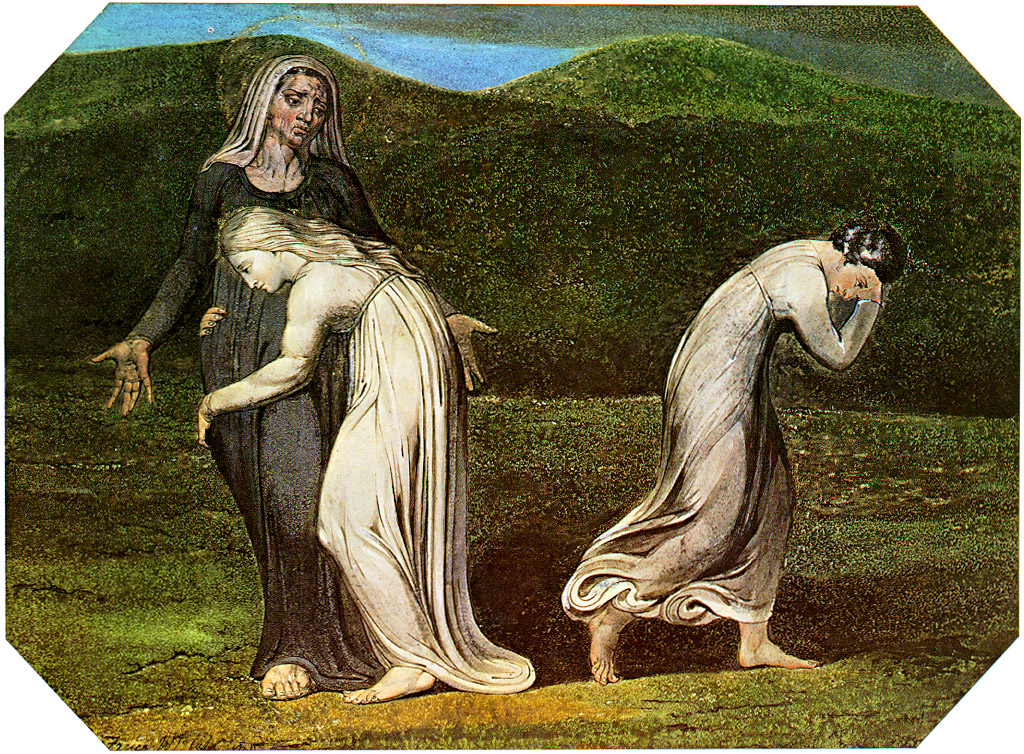
“Where you go I will go.” William Blake, “Naomi Entreating Ruth and Orpah” (1795). On the road out of Moab, Orpah turns back; Ruth clings. A Moabite widow binds herself to Naomi's people and Naomi's God — and steps into the family tree of David.
Victoria and Albert Museum. Public domain, via Wikimedia Commons.
The story is small enough to hold in one hand. A famine drives an Israelite family out of Bethlehem and into Moab, the wrong country, the enemy's country. The father dies. The two sons marry Moabite women and then they die too, leaving three widows with no men, no money, and in that world, no future. One of those widows, a foreigner named Ruth, refuses to leave her grieving mother-in-law and follows her back to Bethlehem with nothing. What happens next, in a barley field and on a threshing floor and at a city gate, looks like a quiet accident of kindness. It is in fact the hand of God writing the opening line of the gospel.
“
Where you go I will go, and where you lodge I will lodge. Your people shall be my people, and your God my God.
Ruth 1:16
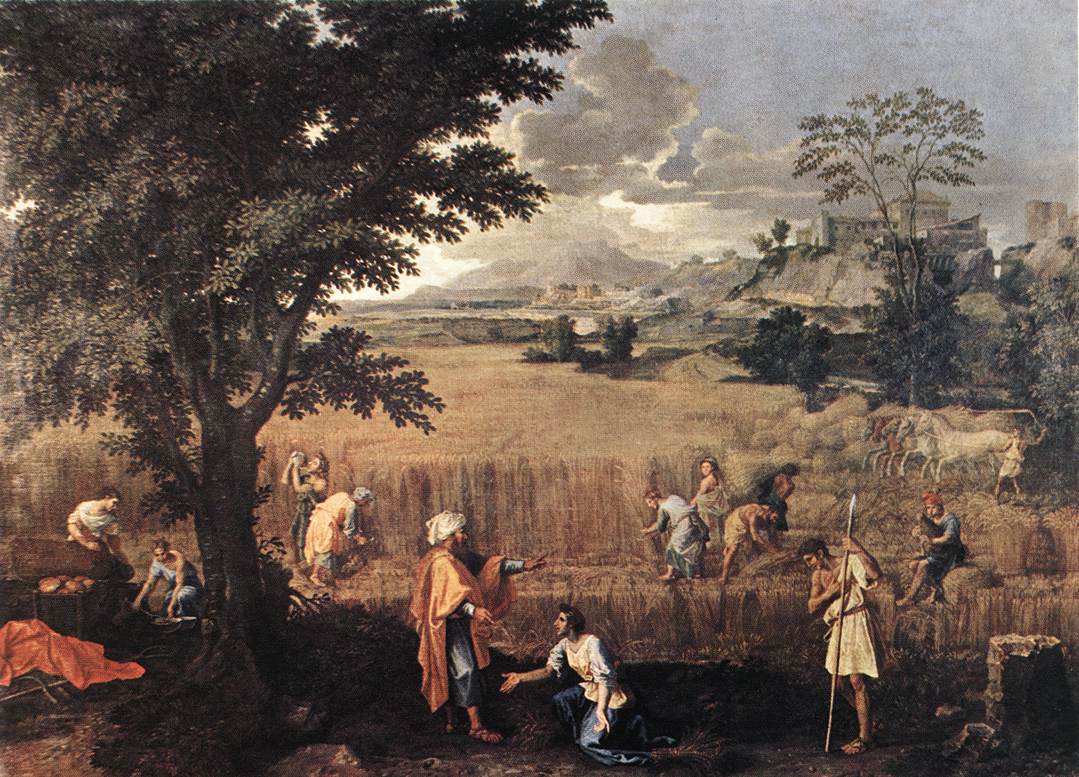
Gleaning in Boaz's field. Nicolas Poussin, “Summer (Ruth and Boaz)” (1660–64). Ruth, gleaning to keep two widows alive, “happens” onto the field of Boaz — the kinsman-redeemer whose quiet kindness turns out to be the hidden hand of God.
Musée du Louvre. Public domain, via Wikimedia Commons.
Setting
The period of the judges, roughly 1100 BC, in Bethlehem of Judah and the fields of Moab.
Key word
hesed — loyal, committed, covenant love. The book is a case study in it.
A quiet God
God never speaks and works no miracle in Ruth, yet His providence guides every step. The hidden hand is the point.
The payoff
The genealogy that closes the book lands on one name: David, and through him, the Messiah.
II · Four Chapters, Four Movements
Walking through the story
❖
Chapter 1 — The road to emptiness
There is famine in Bethlehem, whose name means "house of bread," and the author lets that bitter irony hang in the air. Elimelech takes his wife Naomi and two sons to Moab to survive. He dies there. The sons marry Moabite women, Orpah and Ruth, and after about ten years they die too. Naomi is left with nothing the ancient world counted as security. She decides to go home and urges both daughters-in-law to stay in Moab and rebuild. Orpah, sensibly, weeps and turns back. Ruth clings, and makes the most famous pledge of loyalty in the Old Testament, binding herself not just to a woman but to that woman's God.
They arrive in Bethlehem to a stir of recognition, and Naomi cuts it short: don't call me Naomi, "pleasant," call me Mara, bitter, "for the Almighty has dealt very bitterly with me. I went away full, and the Lord has brought me back empty." She aims her grief straight at God, and the book never scolds her for it. The chapter ends on that word, empty, and on a single thread of hope easy to miss: they came back "at the beginning of barley harvest."
Chapter 2 — The field that "happened" to be his
Ruth goes out to glean, to follow the harvesters and pick up the leftover grain the law commanded farmers to leave for the poor, the widow, and the foreigner (Leviticus 19:9–10). It was legal, but it was hard, exposed, often dangerous work for a vulnerable foreign woman. The narrator then drops a line so understated it is almost a wink: "she happened to come to the part of the field belonging to Boaz." In a book about the hidden hand of God, nothing "happens." Boaz turns out to be a relative of Naomi's dead husband, a man of standing and, more to the point, a man of hesed.
He notices her, protects her, orders his men to leave extra grain on purpose, and invites a destitute Moabite to his own table. When she asks why she has found such favor as a foreigner, his answer names the deepest theme of the book:
12The Lord repay you for what you have done, and a full reward be given you by the Lord, the God of Israel, under whose wings you have come to take refuge.
Ruth 2:12
Ruth will turn that word, "wings," back on Boaz in the very next chapter, and it will change both their lives.
Chapter 3 — The threshing floor
Now Naomi, no longer passive in her grief, makes a plan. She sends Ruth, washed and perfumed, to the threshing floor at night where Boaz is sleeping after the winnowing. Ruth uncovers his feet and lies down. When he wakes, startled, she does something bold: she proposes marriage, and she does it in the language of his own blessing. "Spread your wings over your servant, for you are a redeemer." The word for "wings" is the same word for the corner of a garment. She is asking the man who prayed that God would shelter her under His wings to become the answer to his own prayer.
Boaz is moved, not scandalized. He calls it kindness, hesed, greater than the first, that she did not chase after younger men. He commits to redeem her, but he is too honorable to cut a corner: there is a nearer relative with the prior legal claim, and that man must be given his chance first. Ruth goes home before dawn with six measures of barley and a promise. Naomi, who came back empty, is beginning, grain by grain, to be filled.
Chapter 4 — Redeemed at the gate
Boaz goes up to the city gate, the courtroom of the ancient town, and lays the matter before the nearer redeemer in front of ten elders. The man is glad to redeem Naomi's field, a sound investment, until Boaz adds the condition: redeeming the land means marrying Ruth and raising up an heir in the dead man's name. Suddenly the deal threatens his own estate, and he declines, handing over his sandal to seal it publicly. Boaz redeems all of it, the land and the widow, openly and by the book.
Ruth bears a son, Obed. The women of Bethlehem gather around Naomi and say she has been given a "restorer of life" and a daughter-in-law "who loves you, who is more to you than seven sons." The empty woman holds a grandchild on her lap. And then, in three short verses, the camera pulls all the way back to reveal what the whole story was quietly building: Obed fathered Jesse, and Jesse fathered David.
14Blessed be the Lord, who has not left you this day without a redeemer… 15He shall be to you a restorer of life and a nourisher of your old age.
Ruth 4:14–15
There is no single English word for hesed. It is love that has made a commitment and keeps it; kindness that goes past what is owed; loyalty that costs the giver something real. It is the word the Old Testament reaches for again and again to describe how God loves His people. In Ruth it shows up wearing skin. Ruth shows hesed to Naomi when she has every reason to walk away. Boaz shows hesed to Ruth when he owes her nothing. When you show hesed, you are not just being nice. You are doing the most God-like thing a human being can do.
From empty to full
Naomi's own words trace the arc of the book. "I went away full, and the Lord has brought me back empty" (1:21). Empty is where the story bottoms out, and the author makes you feel it. Then, slowly, against the grain of everything that world expected for a pair of penniless widows, the emptiness reverses. A field, a meal, a redeemer, a wedding, a child on her lap. The same God she blamed for emptying her is the God who fills her again, and He does it not with a thunderclap but through a harvest, a marriage, and a baby. Most of God's filling work in our lives looks just that ordinary while it's happening.
The hidden hand of providence
God never speaks a line of dialogue in Ruth. And yet the characters keep blessing God, and the narrator keeps dropping those telling little "happened to" hints, because the whole book is a meditation on how God works when He seems most silent. A famine, a journey, two deaths, a harvest, an old gleaning law, a quaint custom about sandals, all of it woven together into a rescue no human being planned. Ruth trains your eyes to read your own ordinary days the same way. The God who is not speaking is the God who is still working, and the boring providences are usually the load-bearing ones.
Grace that reaches the outsider
Ruth is a Moabite, and that lands harder than a modern reader feels. Moab began in incest, hired a prophet to curse Israel, and was barred from the assembly of the Lord (Deuteronomy 23:3). She is precisely the kind of person the law seemed built to keep out. Yet she takes refuge under the wings of Israel's God, and He receives her, blesses her, and writes her name into the royal line. The great-grandmother of King David, and an ancestor of Jesus Himself, was a foreigner with a checkered pedigree who simply came home to the true God. No one is too far out for that.
IV · The Heart of the Book
The kinsman-redeemer
The Hebrew word is go'el, the kinsman-redeemer, and it is the engine of the whole story. In Israel's law, when a family fell into ruin, the nearest relative carried the right and the duty to step in and buy back what was lost. The go'el could redeem land that had been sold off, buy a relative out of slavery, and raise up an heir to keep a dead man's name and line alive. In the Bible, redemption is not first an abstract theological idea. It is a family member paying a price out of his own pocket to restore a relative who could not save themselves. That is the shape the word always keeps, right up to the cross.
A redeemer must be related
Only a kinsman could redeem. Boaz qualified because he belonged to the family. Centuries later, the Son of God took on flesh and blood to become our kinsman, so He could redeem us (Hebrews 2:14–17).
A redeemer must be able
The nearer relative could not redeem without ruining his own estate, so he stepped aside. Boaz had the means to pay the price. Christ had the sinless life the price demanded, the one thing none of us could bring.
A redeemer must be willing
No law forced Boaz to want Ruth. He chose her, gladly, at cost. "No one takes my life from me, but I lay it down of my own accord" (John 10:18).
Hold Boaz and Jesus side by side and the picture comes into focus. Boaz redeems a destitute foreign widow who had no claim on him, pays the full price in public, and takes her as his bride, and from that union comes a king. Jesus redeems a people who were "strangers to the covenants of promise" (Ephesians 2:12), pays the full price openly at the cross, and takes the church as His bride, and from that union comes the kingdom of God. Ruth is a working model of the gospel, told four generations before David ever picked up a harp, and a thousand years before another Child was born in the same small town of Bethlehem, "the house of bread," to a people who had run out.
V · The Final Three Verses
From Ruth to David to Christ
The genealogy that closes the book (Ruth 4:18–22) is not an afterthought. It is the reveal the whole story was building toward. The line runs down from a private kindness to the royal road of the Messiah, and it deliberately keeps the outsider women the New Testament remembers.
When Matthew opens his Gospel with the family tree of Jesus, he breaks the custom of his day by naming women, and he chooses startling ones: Tamar, Rahab, Ruth, and Bathsheba. A woman wronged, a Canaanite prostitute, a Moabite widow, and the wife of a man David had murdered. Three of the four were outsiders, and every one of them carried a story the respectable would rather forget. God wove them all into the lineage of the Savior on purpose, and the choice preaches a sermon before Matthew writes a word. The family tree of Jesus is a quiet announcement that He came for exactly these people, the foreign, the scandalous, the grieving, the overlooked, which is to say, for all of us.
People to Know
The three at the center
❖
Ruth
The Moabite who chose
FromMoab
Marked byLoyal love
BecameDavid's great-gran
In Jesus' lineMatthew 1:5
"Your people shall be my people, and your God my God."Ruth 1:16
Lesson: Faith is often a single decision made at a fork in the road, when every sensible voice says turn back. Ruth clung.
Naomi
From bitter to blessed
Name means"Pleasant"
Renamed selfMara, "bitter"
LostHusband, 2 sons
GainedA grandson, Obed
"I went away full, and the LORD has brought me back empty."Ruth 1:21
Lesson: God is patient with honest grief. He did not rebuke Naomi's bitterness; He quietly answered it.
Boaz
The kinsman-redeemer
OfBethlehem
MotherRahab
Known forIntegrity
PicturesChrist our Redeemer
"May you be repaid… under whose wings you have come to take refuge."Ruth 2:12
Lesson: Real godliness shows in how a powerful person treats a vulnerable one. Boaz used his standing to shelter, never to take.
For Discussion & Reflection
Study questions
Talk it through
Ruth's pledge in 1:16–17 costs her everything familiar, including her own gods. What do you think actually moved her, and have you ever made a costly choice like it? Discuss
Hesed in this book is intensely practical: gleaning rights, a shared meal, a public redemption at real cost. What would that kind of loyal love look like, concretely, in your church this month? Discuss
God never speaks in Ruth, yet everyone keeps thanking Him. How do we train ourselves to see His hand in events that, while they're happening, look like coincidence? Discuss
An excluded foreigner ends up in the family tree of the Messiah. How should that reshape the way a church treats the outsider who walks in not knowing the songs? Discuss
Reflect quietly
Naomi went "from full to empty" and named her bitterness out loud to God. Can you bring a grief to Him as honestly as she did, without tidying it up first? Reflect
Boaz pictures Christ: a Redeemer related to you, able to pay, and willing to choose you. Sit with the fact that He chose you, at full cost, when you had no claim on Him at all. Reflect
Where in your ordinary, unapplauded life might a small faithfulness right now be writing a genealogy you will never get to see? Reflect
⚑ Leader Note
Ruth is short enough to read aloud in one sitting, and doing so before you discuss it pays off; the book was built to be experienced whole. Spend real time on hesed and the go'el, since those two words unlock everything else. End by reading the genealogy slowly, out loud. The whole point lands best when people actually hear David's name arrive.
Next Week
Week 8 · Hannah, Samuel & the Ark
Ruth ended with David's name. Now a barren woman prays, a boy hears God in the night, and Israel steps out of the age of judges toward a king. 1 Samuel 1–7.