- TribeManasseh
- EnemyMidian
- ArmyJust 300
- FlawThe golden ephod
"The LORD is with you, O mighty man of valor."Judges 6:12
Lesson: God works through weakness and doubt, but a great victory can rot into idolatry. Finishing well is its own battle.
Movement II · Judges · Week 5 · Judges 6–12
The middle of the book is where the deliverers start to disappoint. A doubter wins an impossible victory and then makes an idol of it. His son crowns himself in blood. An outcast bargains with heaven and loses his daughter. The spiral is tightening.
I · The Middle of the Spiral
Last week the cycle was clean enough to diagram: sin, suffering, a cry, a rescue, a rest. This week you watch it start to corrode from the inside. The deliverers God raises are still real deliverers, and God still saves through them, but the men themselves are cracking. Gideon needs sign after sign and ends his life leading Israel back into idolatry. His son turns the very idea of a leader into a nightmare. Jephthah wins his battle and destroys his own home with a reckless promise. The author is not sanding the edges off these men. He wants you to feel the deliverers getting smaller even as the need gets larger, so that the ache for a different kind of king grows with every chapter.
II · The Breakdown
Open each one for the story, the strategy, and the flaw in the man.
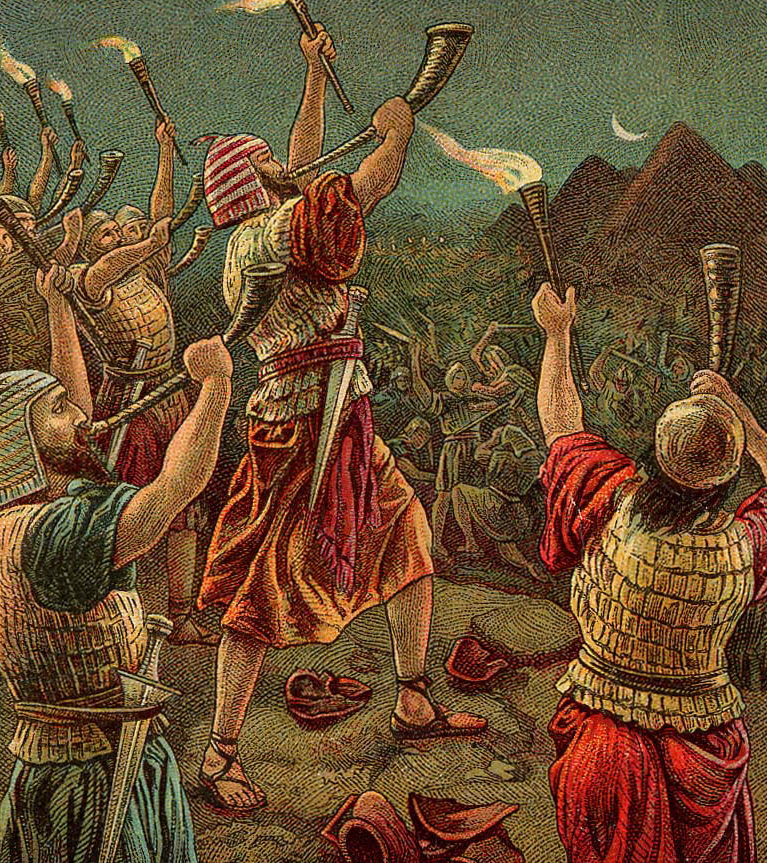
Found threshing wheat down in a winepress to hide it from the Midianites, Gideon is greeted by the angel as "mighty man of valor," which reads as gentle irony given where he is cowering. He asks for sign after sign, the famous fleece laid out twice, before God deliberately whittles his army from thirty-two thousand down to three hundred, "lest Israel boast… saying, 'My own hand has saved me'" (7:2). The night raid with trumpets and torches is a masterpiece of faith. And then it curdles. Gideon collects the gold of victory and makes an ephod, "and all Israel whored after it there, and it became a snare to Gideon and to his family" (8:27). Even the book's most dramatic deliverer plants, with his own hands, the seed of the next rebellion. Success is its own kind of test, and he failed it.
Not a judge but a warning, dropped into the middle of the book. Gideon's son by a concubine murders his seventy half-brothers on a single stone to make himself king of Shechem; only the youngest, Jotham, escapes, to shout down a haunting fable about trees who wanted a king and got a bramble. Three years later the alliance collapses, and Abimelech is mortally wounded when a woman drops a millstone on his head from a tower. He begs his armor-bearer to finish him so no one can say a woman killed him. This is the book's first taste of a self-made king, and it is poison. Israel is not ready for a throne while its heart still belongs to itself.
The son of a prostitute, driven out by his half-brothers, Jephthah becomes a gang leader in the badlands until the very elders who rejected him come crawling back for help against Ammon. He is a shrewd negotiator and a genuine deliverer, but he makes a reckless bargain: if God gives him victory, he will offer up whatever comes out of his door to meet him. What comes out is his only daughter. The text reports the heartbreak without ever applauding the vow. Jephthah is what happens when zeal runs ahead of knowing who God actually is. The God of Israel had outlawed human sacrifice in horror; He never wanted that vow, and a man who knew Him better would have known it.
Othniel had no recorded flaw. Now, at the book's midpoint, Gideon ends his life making an idol and his son murders his way to a crown. The deliverers are getting worse, not better, and the gaps of peace are shrinking. The author is doing this on purpose, exhausting the possibilities of human leadership so that, by the last page, you are ready to admit that Israel does not need a better judge. It needs a different kind of king altogether.
III · Going Deeper
Israel rarely abandoned the Lord outright. They added. They kept worshiping Him and worshiped Baal too, hedging their bets, wanting the covenant God and the fertility god both. That is what made it so deadly, because it never felt like apostasy; it felt like prudence. The book insists there is no stable middle. A heart that tries to serve God and an idol does not stay balanced; it slides, every time, toward the idol. Gideon's golden ephod is the perfect case: a memorial to a real victory that quietly became the thing Israel bowed to. Whatever your Baal is, the thing you reach for alongside God when you're afraid, Judges says it will not stay a junior partner. Given a generation, it runs the house.
Strip Judges down and it is one of the clearest pictures of grace in the whole Bible, precisely because the people are so unworthy of it. They do not clean themselves up before God rescues them. They do not even, most of the time, seem genuinely sorry; they cry out because they are in pain, and God saves them anyway. Over and over He sends a deliverer to a people who have just betrayed Him, for no reason on their side at all. If you have ever wondered whether God could keep loving someone who keeps failing in the same way, Judges is your answer, and the answer is yes, to a degree that is almost scandalous.
People to Know
"The LORD is with you, O mighty man of valor."Judges 6:12
Lesson: God works through weakness and doubt, but a great victory can rot into idolatry. Finishing well is its own battle.
"I have opened my mouth to the LORD, and I cannot take it back."Judges 11:35
Lesson: Zeal without knowledge of God is dangerous. He saves through the rejected, yet warns against bargaining with heaven.
For Discussion & Reflection
Next Week
The strongest and most wasted judge of all, and then two horror stories with no foreign enemy to blame. How dark it really got, and the King it makes you long for. Judges 13–21.