One generation crossed the Jordan on dry ground. Their grandchildren worshiped the gods of the people they were sent to drive out. Judges is the unflinching story of how fast a people can forget, and how stubbornly God refuses to let them go.
I · The Forgetting
How a nation comes apart
There is a single verse near the front of the book that explains everything that follows. After Joshua and his whole generation had died, "there arose another generation after them who did not know the Lord or the work that he had done for Israel" (2:10). Not a generation that rebelled outright. A generation that simply did not know. The stories had stopped being told around the fire. The stones at Gilgal had become just stones. And a people who forget what God has done will always, eventually, start worshiping something else.
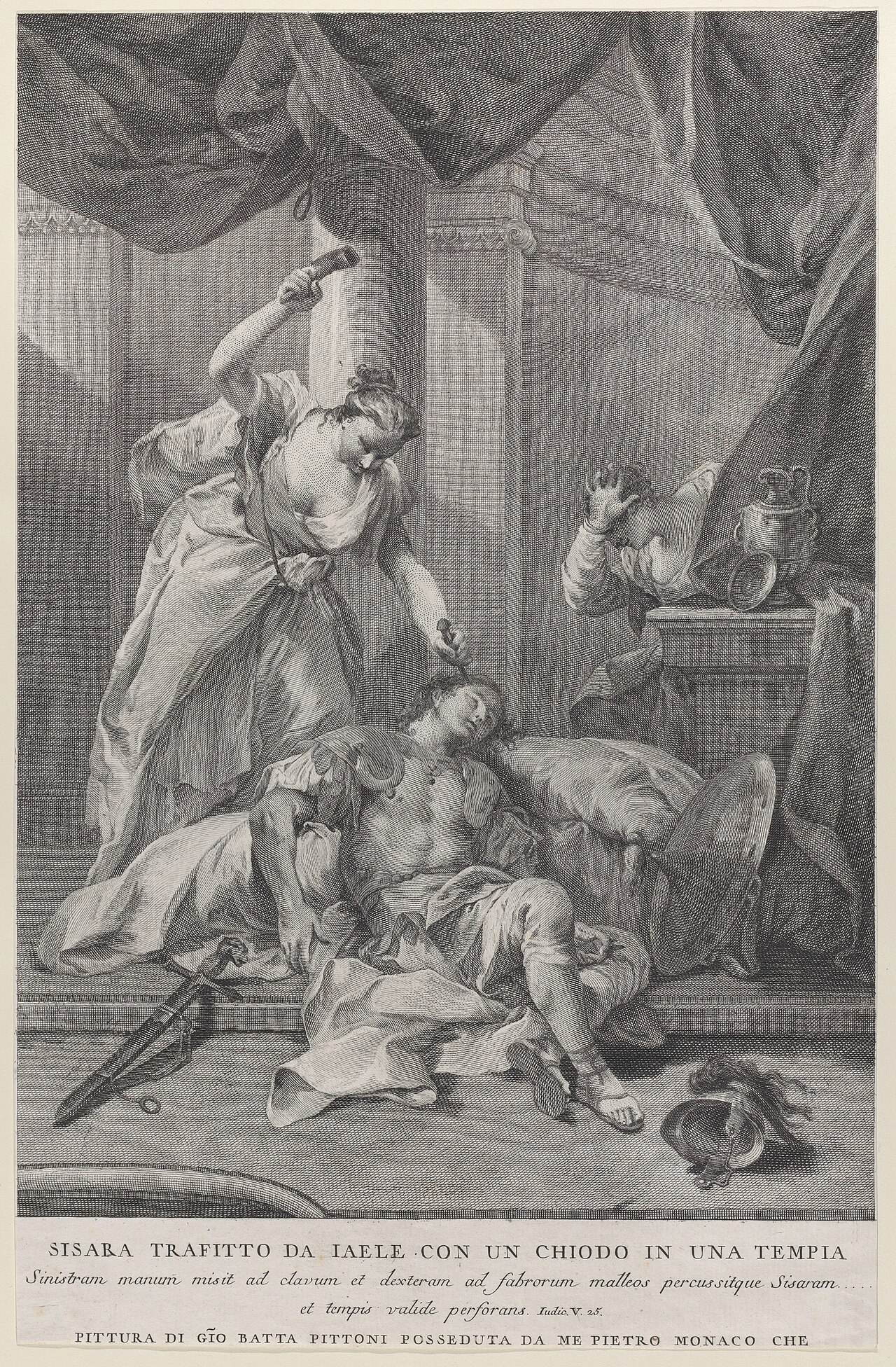
The unlikeliest deliverer. Jael and Sisera (Judges 4–5). When Deborah the prophetess and Barak routed the Canaanite army, its fleeing general was killed not by a soldier but by a woman with a tent peg — and Deborah's song made her a hero. In the age of the judges, God keeps rescuing through the people no one expects.
The Metropolitan Museum of Art. CC0, via Wikimedia Commons.
That is the engine of Judges. The book spans roughly three centuries, from the death of Joshua to the eve of the monarchy, and it is not a tidy history. It loops. Israel sins, suffers, cries out, and is rescued, then turns around and does it all again. The author steps out from behind the curtain in chapter 2 and tells you plainly that this is the pattern (2:11–19), so that by the time you watch it grind through Othniel, Deborah, Gideon, and the rest, you already know how each story ends. The tragedy is not that you can't see it coming. It's that they couldn't.
Two sentences frame the whole book like bookends, appearing first in chapter 17 and again as its very last verse:
“
In those days there was no king in Israel. Everyone did what was right in his own eyes.
Judges 21:25
Read it one way and it sounds like freedom. Read it the way the author means it and it is a verdict. With no king to lead them, and no shared submission to the King of heaven, "right in his own eyes" became the only standard left, and the book ends in idolatry, abduction, and civil war. Judges is doing something deliberate to you. It is making you homesick for a king who has not yet come.
Timeframe
Roughly 1375–1050 BC, from Joshua's death to Samuel and the first king.
Structure
A repeating cycle of decline (ch 3–16), framed by a prologue (1–2) and a dark double epilogue (17–21).
"Judge"
Not a courtroom official but a deliverer God raised up to rescue and lead Israel for a season.
Big idea
The faithfulness of God meeting the faithlessness of His people, and the growing ache for a true King.
II · The Engine of the Book
The cycle of the judges
The same five stages turn through nearly every chapter. Click each stage on the wheel to read what it looked like and where Scripture describes it.
Stage One
Rebellion
"The people of Israel did what was evil in the sight of the Lord and served the Baals" (2:11). After every season of peace, a new generation drifted to the gods of the land. The root sin was not dramatic; it was forgetting. They stopped telling the story, and a people who lose the memory of grace will always reach for another god to fill the silence.
Stage Two
Retribution
"He gave them over to plunderers… and he sold them into the hand of their surrounding enemies" (2:14). God did not hurl thunderbolts; He withdrew His hand and let the natural consequence of idolatry arrive in the form of foreign oppression. Sin's wages came due, and the very nations Israel had admired became the nations that crushed them.
Stage Three
Repentance — or at least a cry
"The people of Israel cried out to the Lord" (3:9). Pain drove them back. Whether it was deep repentance or just the groan of the miserable is left honestly unclear, and as the book goes on the crying out sounds less and less like real turning. Yet God listens to the cry of His people even when their hearts are only half in it.
Stage Four
Rescue
"The Lord raised up a deliverer… who saved them" (3:9). Here is the relentless surprise of the book: God keeps showing up. Moved by compassion and bound to His covenant, He raises a judge and rescues a people who have done nothing to earn it. The deliverance is always grace, never wages. Read the cycle long enough and you realize it is less a story about Israel's failure than about God's mercy that will not quit.
Stage Five
Rest — until it isn't
"And the land had rest forty years" (3:11). Under the judge, peace returned. But the peace was only ever as durable as the leader, and the leaders kept dying. "Whenever the judge died, they turned back and were more corrupt than their fathers" (2:19). The rest never held, because the problem was never only the enemy outside. It was the heart inside, and no judge could fix that.
★ It's a spiral, not a circle
The stages repeat, but the nation does not return to where it started. Each turn sinks lower: the judges grow more flawed, the deliverances messier, the people more broken, until the book ends in horrors no foreign army inflicted. A staircase spiraling down is a truer picture than a wheel. And every step asks the same unanswered question: who will finally break this thing?
III · The Whole Roster
The twelve judges at a glance
Six judges get full stories (the "major" judges); six are named in just a verse or two (the "minor" judges). One man, Abimelech, seized power and was no deliverer at all. We meet the first four this week; Gideon onward come in the next two weeks.
Judges in the order they appear (Judges 3–16).
Judge
Tribe / Region
Oppressor
Oppression
Peace / Term
Reference
Othniel
Judah
Aram (Cushan-rishathaim)
8 yrs
40 yrs
Judg 3:7–11
Ehud
Benjamin
Moab (Eglon)
18 yrs
80 yrs
Judg 3:12–30
Shamgar
unknown
Philistines
—
—
Judg 3:31
Deborah & Barak
Ephraim / Naphtali
Canaan (Jabin & Sisera)
20 yrs
40 yrs
Judg 4–5
Gideon
Manasseh
Midian
7 yrs
40 yrs
Judg 6–8
Abimelech
Manasseh (Shechem)
self-appointed king
—
3 yrs
Judg 9
Tola
Issachar
—
—
23 yrs
Judg 10:1–2
Jair
Gilead
—
—
22 yrs
Judg 10:3–5
Jephthah
Gilead
Ammon
18 yrs
6 yrs
Judg 10:6–12:7
Ibzan
Bethlehem
—
—
7 yrs
Judg 12:8–10
Elon
Zebulun
—
—
10 yrs
Judg 12:11–12
Abdon
Ephraim
—
—
8 yrs
Judg 12:13–15
Samson
Dan
Philistines
40 yrs
20 yrs
Judg 13–16
★ A pattern hiding in the list
Read the judges in order and you notice the line is sloping down. Othniel, the first, has no recorded flaw. By the middle, Gideon ends his life making an idol. By the end, Jephthah sacrifices his daughter and Samson can't keep a single vow. The deliverers are getting worse, not better, and the gaps of peace are shrinking. The author is doing this on purpose. He is exhausting the possibilities of human leadership so that, by the last page, you are ready to admit that Israel does not need a better judge. It needs a different kind of king altogether.
IV · The Breakdown
The first four deliverers
Open any judge to read the story, the strategy, and the point the writer wants you to notice.
Caleb's younger kinsman, and the only judge from Judah. His account is short and clean, almost a template: Israel sins, Aram oppresses, the people cry out, the Spirit of the Lord rushes on Othniel, and the land rests forty years. He is the one judge with no recorded flaw, and he is placed first on purpose. He is the measuring stick. Everything that comes after is graded against how far it falls from this simple, Spirit-empowered faithfulness.
A left-handed man from Benjamin, a tribe whose name means "son of the right hand," so the story opens with a quiet joke. Ehud hides a homemade double-edged sword on his right thigh, where no guard would think to search, gains a private audience with the obese Moabite king Eglon, and kills him. The grisly, almost slapstick detail underlines a serious point that runs through the whole book: God delights to work through the overlooked, the disqualified, the man nobody would pick. Eighty years of peace followed, the longest rest in Judges.
One verse, one weapon, six hundred Philistines. Shamgar struck them down with an oxgoad, a long wooden farm tool for prodding cattle. He has no genealogy, no recorded term, just a single act of courage with whatever happened to be in his hand. Sometimes faithfulness is nothing more spiritual than refusing to wait for a better weapon before you obey.
Deborah is a prophetess and the only judge who actually judges in the legal sense, settling disputes under her palm tree. When she summons Barak to face Sisera's nine hundred iron chariots, he will only go if she comes with him, so she tells him the glory of the victory will go to a woman instead. It does, twice over: to Deborah who led when the men hesitated, and to Jael, who drove a tent peg through the sleeping Sisera's skull. Chapter 5 preserves their victory song, one of the oldest poems in the Bible. The whole episode is a gentle, pointed rebuke to a generation of men who would not step up.
V · Pressure From Every Side
Where the enemies came from
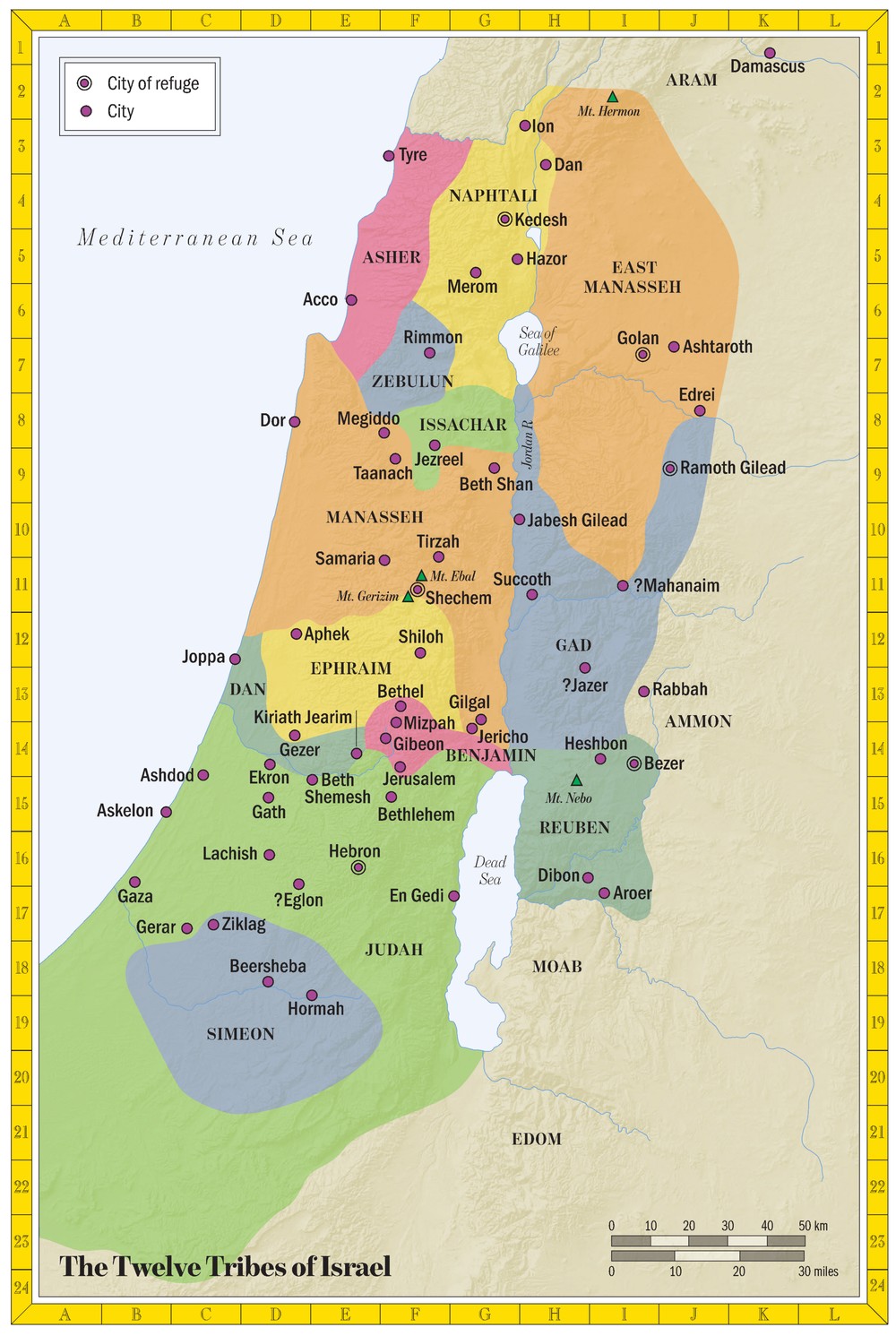
Israel's tribal territories sat ringed by hostile nations — Aram to the northeast, Ammon and Moab across the Jordan, Edom to the south, the Philistines on the coast. The table below names which oppressor pressed in from where, and which judge God raised to meet them. Click the map to enlarge it.
Map: Biblica, Inc. — “Open Bible Maps,” CC BY-SA 4.0
A small nation surrounded. Part of God's stated purpose in leaving these nations was "to test Israel" and to teach a generation with no experience of war (Judges 3:1–2).
Each oppressor pressed in from a different direction, and God raised a deliverer to meet them.
Oppressor
Pressed in from
Deliverer raised up
Aram (Mesopotamia)
The far northeast
Othniel
Moab
The east, across the Jordan
Ehud
Canaan (Hazor)
The north
Deborah & Barak
Midian
The eastern desert
Gideon
Ammon
The east, in Gilead
Jephthah
Philistia
The southwest coast
Shamgar & Samson
People to Know
The prophetess who led when the men hung back
❖
Deborah
Prophetess & judge
EnemySisera's chariots
AllyBarak; Jael
Peace won40 years
LegacyA song (Judg 5)
"Does not the LORD go out before you?"Judges 4:14
Lesson: God raises up whoever is willing. Deborah led when the men hung back, and handed every ounce of glory to God.
For Discussion & Reflection
Study questions
Talk it through
The whole spiral starts because one generation "did not know the Lord or his works." What does it actually take to hand faith down, and where do you see that transfer breaking today? Discuss
God rescues a people who never really repent, again and again. What does the cycle reveal about His character that we'd miss if we only read the tidy stories? Discuss
God kept working through the overlooked and the disqualified, a left-handed man, a farmer with a stick, a woman when the men hung back. Who does that make you rethink? Discuss
The deliverers get worse as the book goes on, building a hunger for a true King. How does that change the way you read them, not as heroes but as signposts? Discuss
Reflect quietly
Is there a cycle in your own life that keeps turning, the same sin, the same regret, the same fresh start? What would it look like to bring the root to God instead of just managing the symptom again? Reflect
"They did not know the Lord or his works." Whose job is it to tell the story to the next generation around you, and are you doing it? Reflect
Next Week
Week 5 · Gideon & the Unraveling
A doubter with three hundred men, a son who crowns himself, and an outcast whose reckless vow ends in heartbreak. The spiral tightens. Judges 6–12.