The trumpets fall silent and the surveyors take over. The long second half of Joshua reads like a property deed, and that is exactly the point: the promise, paid in full, surveyed and signed. Then an old leader forces one last choice.
I · The Deed of Inheritance
Why the boring chapters matter
The long second half of Joshua can feel like reading a property registry, and that is the point. God parcels out the land tribe by tribe, by lot, at Shiloh. Eighty-five-year-old Caleb strides up to claim the hill country he was promised forty-five years before, asking for the part with the giants still in it. The cities of refuge are set apart. Every boundary line is a receipt: the promise, paid in full, surveyed and signed.
The book divides cleanly in two. Chapters 1 to 12 told how Israel took the land; chapters 13 to 24 tell how Israel divided it. The first half rang with trumpets and falling walls; the second reads like a surveyor's deed, full of boundary lines and town names. Both halves are pressing the same truth from different sides. The writer wants you to feel the sheer, patient thoroughness of God keeping His word, one town at a time, until there is nothing left to give.
See the Land
The tribes and the cities of refuge
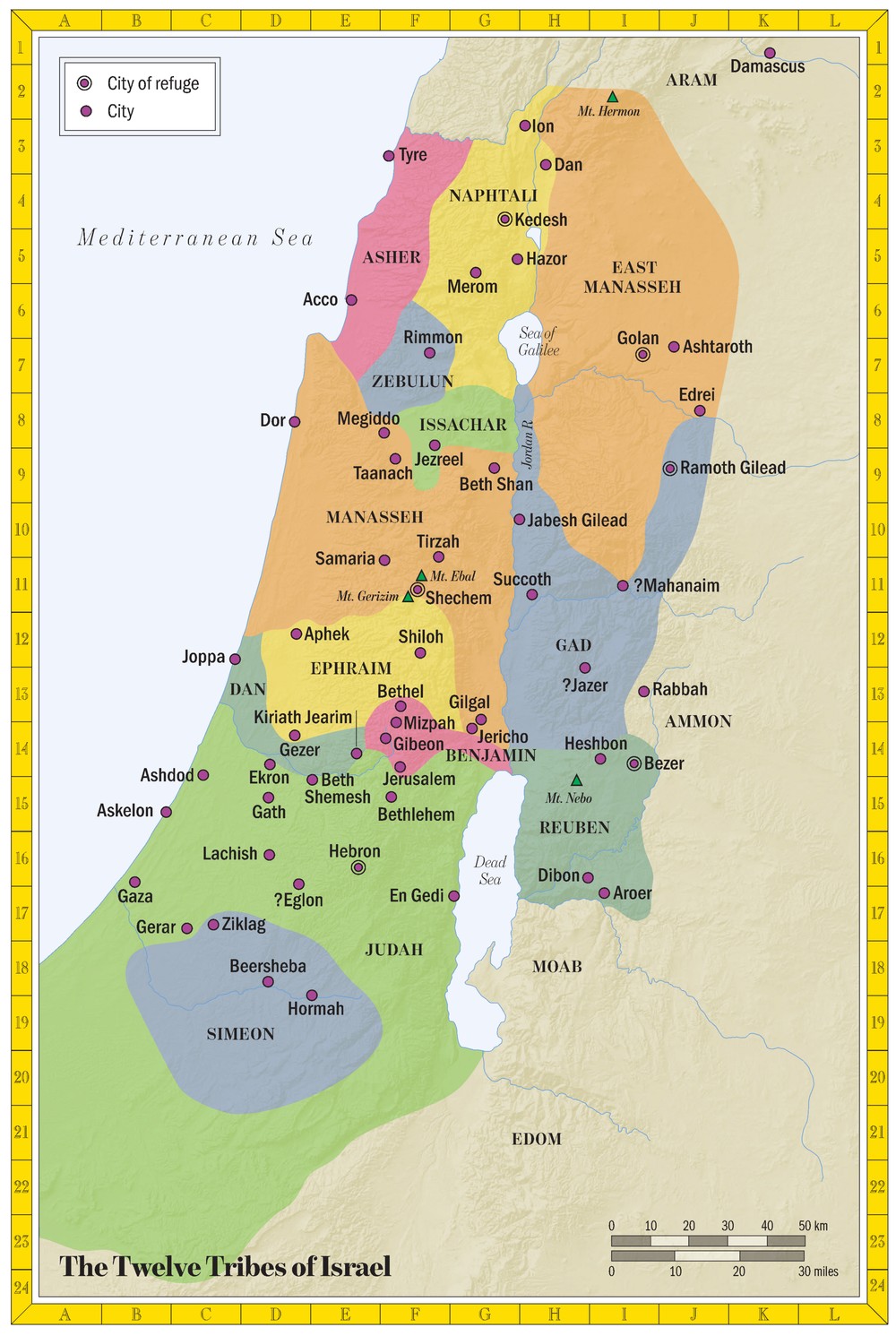
Once the land was taken, it was divided by lot among the tribes. Click any tribe below to read its inheritance and what the rest of Scripture says about it. Click the map to enlarge it.
Map: Biblica, Inc. — “Open Bible Maps,” CC BY-SA 4.0
Explore each tribe
Tribal Allotment
Pick a tribe
Choose any tribe above to read who settled there, the cities they held, and what the rest of Scripture says about them.
Note the half-tribe of Manasseh, split by the Jordan, and that Levi received no land at all.
Going Deeper · The missing tribe
Count the tribes and the math feels off. Levi gets no territory, because "the Lord God of Israel is their inheritance" (Joshua 13:33); the priestly tribe lived in forty-eight scattered towns instead, salt worked through the whole nation. To keep the number at twelve, Joseph is counted as two tribes through his sons Ephraim and Manasseh. So there are twelve land-holding tribes, with Levi set apart for the service of God in the middle of them all — a people whose portion was not a place but God Himself.
Tribal Allotment
Asher
The northwest, a strip of fertile coast running up toward Phoenicia (Joshua 19:24–31). The name means "happy" or "blessed."
Key area
The coastal plain near Acco and Mount Carmel's slopes.
Watch for
Asher never drove out the coastal Canaanites and "lived among" them (Judges 1:31–32) — a foothold the book of Judges shows turning costly.
Tribal Allotment
Naphtali
The northern hill country west of the Sea of Galilee (Joshua 19:32–39), with Hazor on its border and Kedesh, a city of refuge, within it.
Key cities
Kedesh-Naphtali, near Hazor.
Watch for
Barak, who fought alongside Deborah, came from Kedesh in Naphtali (Judges 4). Isaiah promised this dark northern region would one day see a great light (Isaiah 9:1–2).
Tribal Allotment
Zebulun
Lower Galilee, set between the Sea of Galilee and the Mediterranean (Joshua 19:10–16). Jacob had linked Zebulun to the sea and to trade (Genesis 49:13).
Key area
The hills around what would later be Nazareth.
Watch for
Jesus grew up in territory once allotted to Zebulun and Naphtali (Matthew 4:13–16).
Tribal Allotment
Issachar
The rich farmland of the Jezreel Valley (Joshua 19:17–23), the breadbasket and the battlefield of northern Israel.
Key area
The Jezreel (Esdraelon) Valley, below Mount Tabor.
Watch for
Issachar later produced men "who had understanding of the times, to know what Israel ought to do" (1 Chronicles 12:32).
Tribal Allotment
Manasseh — the divided tribe
Joseph's elder son, given a double portion split by the Jordan. West Manasseh held central hill country; East Manasseh held Bashan and northern Gilead (Joshua 13; 17).
Key fact
The daughters of Zelophehad received their father's inheritance here, a landmark moment for inheritance law (Joshua 17:3–6).
Watch for
Being split by the river left East Manasseh exposed and often the first to suffer in later invasions.
Tribal Allotment
Ephraim
Joseph's younger son, given the greater blessing (Genesis 48). Central hill country holding Shiloh, where the tabernacle stood for centuries, and Shechem (Joshua 16).
Key cities
Shiloh and Shechem.
Watch for
Joshua himself was an Ephraimite. Ephraim grew so dominant that its name became shorthand for the whole northern kingdom.
Tribal Allotment
Dan
First given a small territory on the coastal plain beside the Philistines (Joshua 19:40–48). Pressed hard by the Amorites, much of the tribe later migrated far north and seized Laish, renaming it Dan (Judges 18).
Key fact
Samson, the strongman judge, was a Danite.
Watch for
"From Dan to Beersheba" became the way Israel described its whole length, north to south.
Tribal Allotment
Benjamin
The smallest tribe by numbers, wedged between Ephraim and Judah (Joshua 18:11–28). It held the border around Jerusalem, plus Jericho, Bethel, and Gibeon.
Key fact
Saul, Israel's first king, and later the apostle Paul, both came from Benjamin.
Watch for
Judges ends with a civil war that nearly wipes Benjamin out entirely (Judges 19–21).
Tribal Allotment
Judah — the royal tribe
The largest southern territory (Joshua 15), and the tribe Jacob said would hold the scepter (Genesis 49:10). It contained Hebron, and later Bethlehem and Jerusalem.
Key cities
Hebron (a city of refuge), Bethlehem, Jerusalem.
Watch for
David came from Judah, and the New Testament calls Jesus "the Lion of the tribe of Judah" (Revelation 5:5).
Tribal Allotment
Simeon
Given towns inside Judah's southern territory rather than a block of its own (Joshua 19:1–9), including Beersheba.
Key fact
Jacob had prophesied Simeon would be "divided" and "scattered" in Israel (Genesis 49:7).
Watch for
Over time Simeon was largely absorbed into Judah, exactly as foretold.
Tribal Allotment
Gad
Settled east of the Jordan in the heart of Gilead (Joshua 13:24–28), choosing the land for its good pasture (Numbers 32).
Key city
Ramoth-Gilead, a city of refuge.
Watch for
The Gadites were fierce warriors "swift as gazelles upon the mountains" (1 Chronicles 12:8), but their exposed eastern land made them an early target for raiders.
Tribal Allotment
Reuben
Jacob's firstborn, who forfeited his birthright (Genesis 49:3–4). Reuben chose to settle east of the Jordan, east of the Dead Sea (Numbers 32; Joshua 13).
Key fact
Reuben, Gad, and East Manasseh built a great altar by the Jordan that nearly triggered a civil war until it was explained as a witness, not a rival (Joshua 22).
Watch for
Settling outside the Jordan kept these tribes on the margins of Israel's later life.
The Six Cities of Refuge
God set apart six towns where a person who killed someone accidentally could flee and be safe from the avenger of blood until a fair trial (Joshua 20). Three sat west of the Jordan, three east, spaced so that no Israelite was ever far from refuge.
West of the Jordan
Kedesh Far to the north, in the hills of Naphtali.
Shechem In the central hill country of Ephraim.
Hebron In the southern territory of Judah.
East of the Jordan
Golan In Bashan, in the half-tribe of Manasseh.
Ramoth-Gilead In Gilead, in the territory of Gad.
Bezer On the eastern plateau of Reuben.
★ Why this matters
These six towns drew a careful line between murder and manslaughter that most of the ancient world never bothered with, protecting the innocent from blood-vengeance and the land from being defiled by wrongful death. But look closer and there is a picture of the gospel hiding in the law. A guilty-feeling person runs for their life to a place of refuge God Himself appointed, and stays safe there until the death of the high priest sets them free to go home (Numbers 35:25–28). A death that releases the guilty; a refuge God provides. The writer of Hebrews seems to have these cities in mind when he describes believers as those who "have fled for refuge" to lay hold of the hope set before us (Hebrews 6:18).
II · Going Deeper
Already, and not yet
Here is a tension that will save you a lot of confusion, not just in Joshua but in the whole Christian life. God declares the entire land already given: "I have given you the land" (1:3). And yet Israel has to fight for it, town by town, and even at the end God says, "there remains yet very much land to possess" (13:1). So which is it, given or not given? Both. The victory is settled in heaven and unfinished on the ground at the same time. The New Testament lives in exactly this tension. You are already saved, already seated with Christ, already given every spiritual blessing, and you are also told to fight sin, to put on armor, to take ground you have not yet taken. Joshua teaches you to hold the certainty and the struggle together without letting go of either. The promise is sure. The work is real. Rest in the first; get up and do the second.
A rest that doesn't quite arrive
Near the end, the book exhales: "the Lord gave them rest on every side" (21:44). The wandering is over; the people are home. It should be the happy ending. And yet something nags. The land is not fully cleared, the peace will not hold a single generation (Judges is coming), and centuries later the book of Hebrews makes a startling claim about this very moment:
8For if Joshua had given them rest, God would not have spoken of another day later on. 9So then, there remains a Sabbath rest for the people of God.
Hebrews 4:8–9
Joshua's rest was real, but it was a rest with an asterisk, a deposit pointing past itself. The true and final rest, the one Eden lost and Canaan only sketched, does not come through a stretch of conquered dirt. It comes through a greater Joshua. Which is exactly where the book has been quietly pointing all along.
People to Know
The old warrior who would not retire
❖
Caleb
The old warrior of faith
TribeJudah
Age at claim85 years
InheritanceHebron
Marked byWholehearted faith
"Give me this hill country… I am still as strong today as I was in the day Moses sent me."Joshua 14:11–12
He waited forty-five years to receive a promise made in his prime, then asked for the part with giants in it. Lesson: faith does not retire, and it does not ask for the easy ground.
III · The Charge to Choose & Christ in Joshua
"Choose this day"
At the very end, old and near death, Joshua gathers the tribes at Shechem, the exact spot where God first promised Abram this land generations before (Genesis 12:6–7). He retells the whole story in God's own voice, and then forces the question the entire book has been building toward.
15And if it is evil in your eyes to serve the Lord, choose this day whom you will serve… But as for me and my house, we will serve the Lord.
Joshua 24:15
What follows is one of the strangest pastoral moves in Scripture. The people enthusiastically promise to serve God, and Joshua tells them flatly, "You are not able to serve the Lord" (24:19). He is not trying to discourage them. He is puncturing the cheap confidence of people who think covenant faithfulness is a matter of willpower. Real obedience has never come from gritted teeth. It comes from grace that changes the heart, and Joshua wants them to feel the gap between their good intentions and their actual ability, because only people who know they cannot do it on their own will ever lean hard enough on the One who can.
❖
And that is the thread to pull as the book closes. The leader's name is Yehoshua, the very name that comes into Greek as Jesus. He leads God's people through the waters and into their inheritance. He fights battles that are really God's. He gives a rest that points past itself to a greater rest. A foreign woman is saved by a scarlet cord and folded into the people of God. Every one of these is a sketch, drawn centuries early, of the One the New Testament announces as the true and better Joshua: the Savior who leads us through death into the inheritance that does not fade, and gives the rest that finally holds.
For Discussion & Reflection
Study questions
Talk it through
The long "boring" chapters are a receipt for God keeping His word one town at a time. Where do you need to notice God's patient, unglamorous faithfulness in the details of your own life? Discuss
"Already given" and "still to be taken" describe the land and also the Christian life. Where do you most need to rest in what's settled, and where do you most need to get up and fight? Discuss
The cities of refuge hid the guilty until a death set them free. How does that law quietly preach the gospel to you? Discuss
Joshua told an eager crowd, "You are not able." Where have you been serving God on willpower, and what would change if you admitted you can't? Discuss
Reflect quietly
Joshua 21:45 says not one of God's good promises failed. Name the promise you're still waiting on. What would it look like to wait the way Caleb waited, for forty-five years, without losing heart? Reflect
"As for me and my house, we will serve the Lord." What would it mean to make that choice, concretely, in your household this week? Reflect
⚑ Leader Note
The "already / not yet" idea is the single most practically useful thing your group will carry out the door, so give it room. Close by reading Hebrews 4:8–9 aloud and letting the better-Joshua connection land, then let the "choose this day" charge sit unhurried before you pray. This closes the book of Joshua; next week the story turns dark fast.
Next Week
Week 4 · The Cycle & the Early Judges
Joshua's generation served the Lord. The very next "did not know the Lord," and the long downward spiral begins. Judges 1–5.