Movement I · Joshua · Week 2 · Joshua 6–12

Jericho, Achan & the Campaigns

The walls fall to a procession, not a battering ram, so that no one can mistake whose victory it is. Then a single hidden sin stops the whole nation cold, and the writer makes his sharpest point of all.

I · The Campaign

How to take a land you were given

Last week God settled who was in charge and re-formed His people at Gilgal. Now the fighting begins, and the strategy is God's, not Joshua's. Israel drives a wedge into the center of the land to split it in two, then turns south, and finally north. But the way the book tells these campaigns keeps undercutting any sense that Israel won them by force. The greatest city falls without a weapon lifted, the biggest defeat comes from within, and the most dramatic victory is credited flatly to God stopping the sun. All through these chapters, the writer refuses to let Israel take the credit.

There is a rhythm here worth naming before we walk the scenes. When Israel listens to God, the impossible happens. When Israel leans on its own eyes, whether in Achan's greed or the Gibeonite treaty signed without prayer, it stumbles. The land was already given; the only question was whether Israel would take it God's way or its own.

II · The Story, Scene by Scene

Four scenes across the land
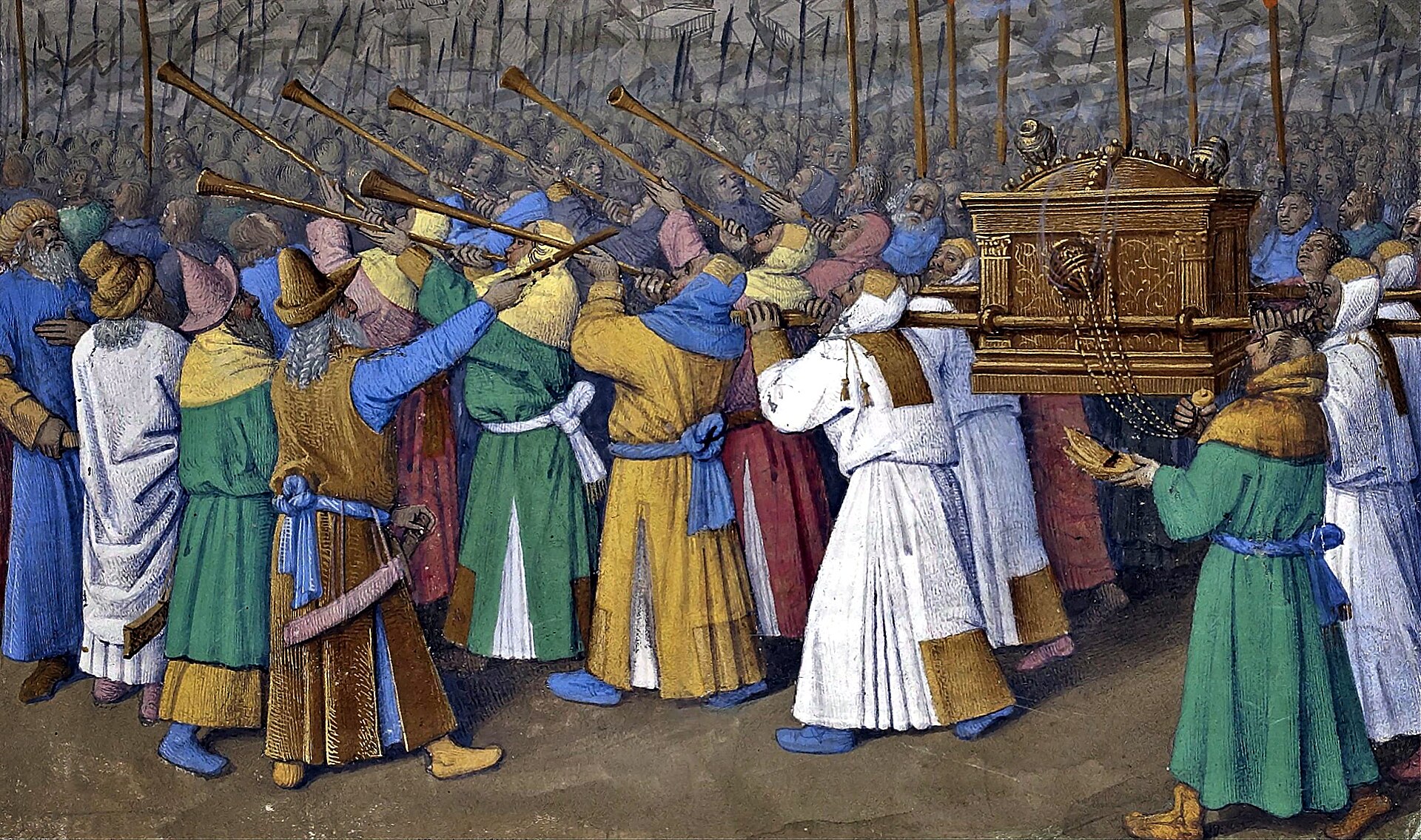
Medieval illumination of Israelite priests carrying the Ark and blowing trumpets around Jericho
The walls fall to a procession. Jean Fouquet, The Taking of Jericho (c. 1470–75). The priests carry the ark and blow the rams’ horns; no siege works, no battering ram — only a march, trumpets, and a shout, so no one could mistake whose victory it was. Public domain, via Wikimedia Commons.
Joshua 6

Jericho falls to a procession

God's battle plan is almost comic as military strategy: march around the city once a day for six days, seven times on the seventh, blow trumpets, and shout. No siege works, no ladders, no ram. When the walls collapse, no one can mistake whose victory it is. That is precisely the design. Hebrews remembers it as faith: "By faith the walls of Jericho fell down, after they had been encircled for seven days" (Hebrews 11:30). And out of the rubble, only one household stands, marked by a scarlet cord.

Joshua 7–8

Achan, and the cost of a hidden sin

Then comes the gut-punch. Tiny Ai routs Israel, and God tells Joshua why: "Israel has sinned" (7:11). One man, Achan, had taken plunder devoted to God, yet God says Israel sinned, because in the covenant no sin is ever truly private. Achan buried silver and a robe under his tent and thought no one saw; the cost surfaced in dead soldiers on a hillside. Place him beside Rahab and the writer's point is unmistakable. The Canaanite outsider lives by faith; the Israelite insider perishes by greed. Belonging to God's people has never been about the right last name.

Joshua 9

The treaty Joshua never prayed about

The Gibeonites arrive in moldy bread and worn-out sandals, pretending to be from a distant land, and Israel signs a peace treaty with them. The verdict is quiet and devastating: "they did not ask counsel from the Lord" (9:14). Joshua, who could not lose a battle when he listened, gets fooled the moment he trusts his own eyes. Centuries later God will still hold Israel to that oath (2 Samuel 21), a reminder that even our prayerless decisions have long lives.

Joshua 10–12

The day the sun stood still

Five kings attack Gibeon for surrendering, and Joshua marches all night to defend the people he was tricked into protecting. In the heat of it he prays the boldest prayer in the Old Testament, that the sun would stop, and it does. Endless ink has been spilled on the astronomy, but the writer tells you flatly what matters: "There has been no day like it before or since, when the Lord heeded the voice of a man, for the Lord fought for Israel" (10:14). The miracle is not the headline. The headline is that God fights for His people.
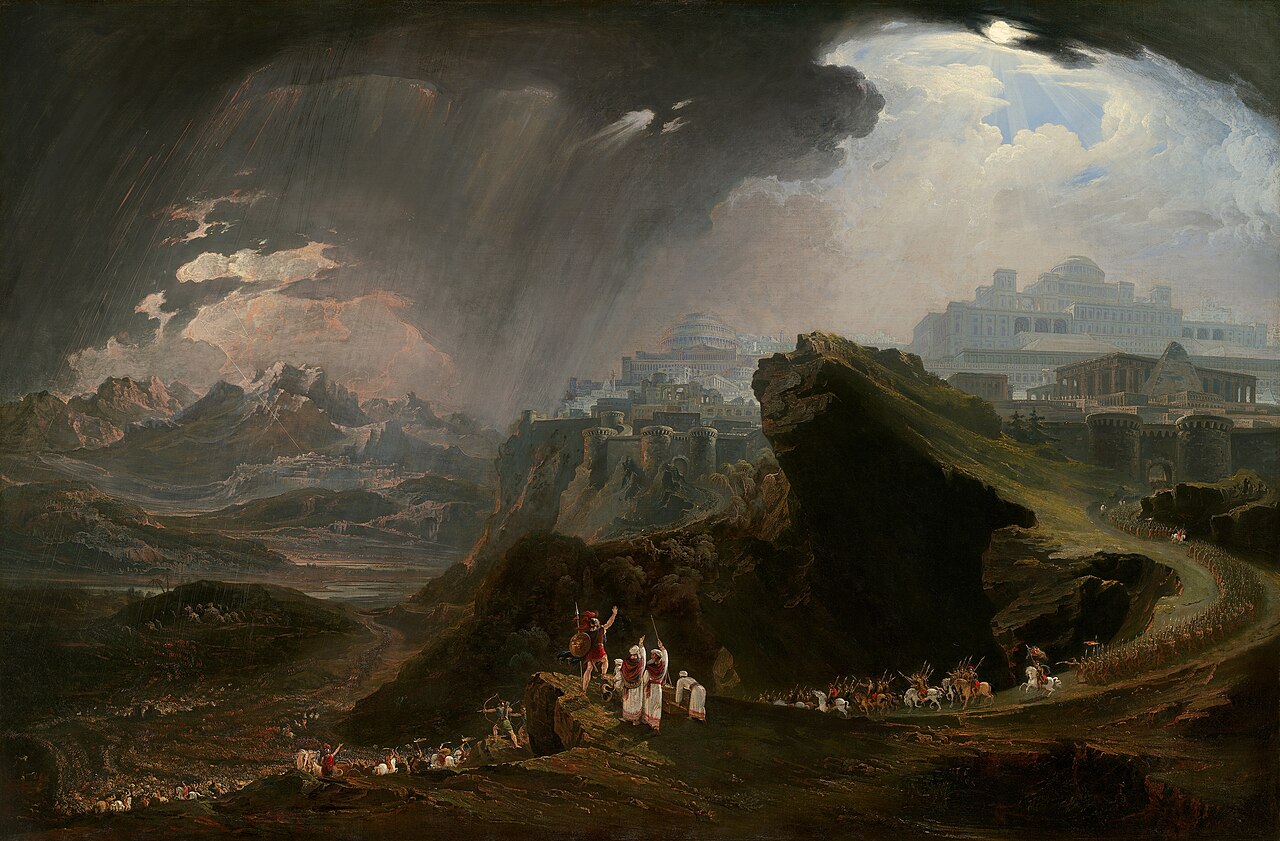
John Martin's dramatic panoramic painting of Joshua commanding the sun to stand still over a vast, storm-lit battlefield at Gibeon.
“Sun, stand still.” John Martin, “Joshua Commanding the Sun to Stand Still upon Gibeon” (1816). Martin dwarfs the armies beneath a churning sky — the day the Lord “heeded the voice of a man, for the Lord fought for Israel.” National Gallery of Art, Washington. Public domain, via Wikimedia Commons.

See the Land

The Conquest of Canaan

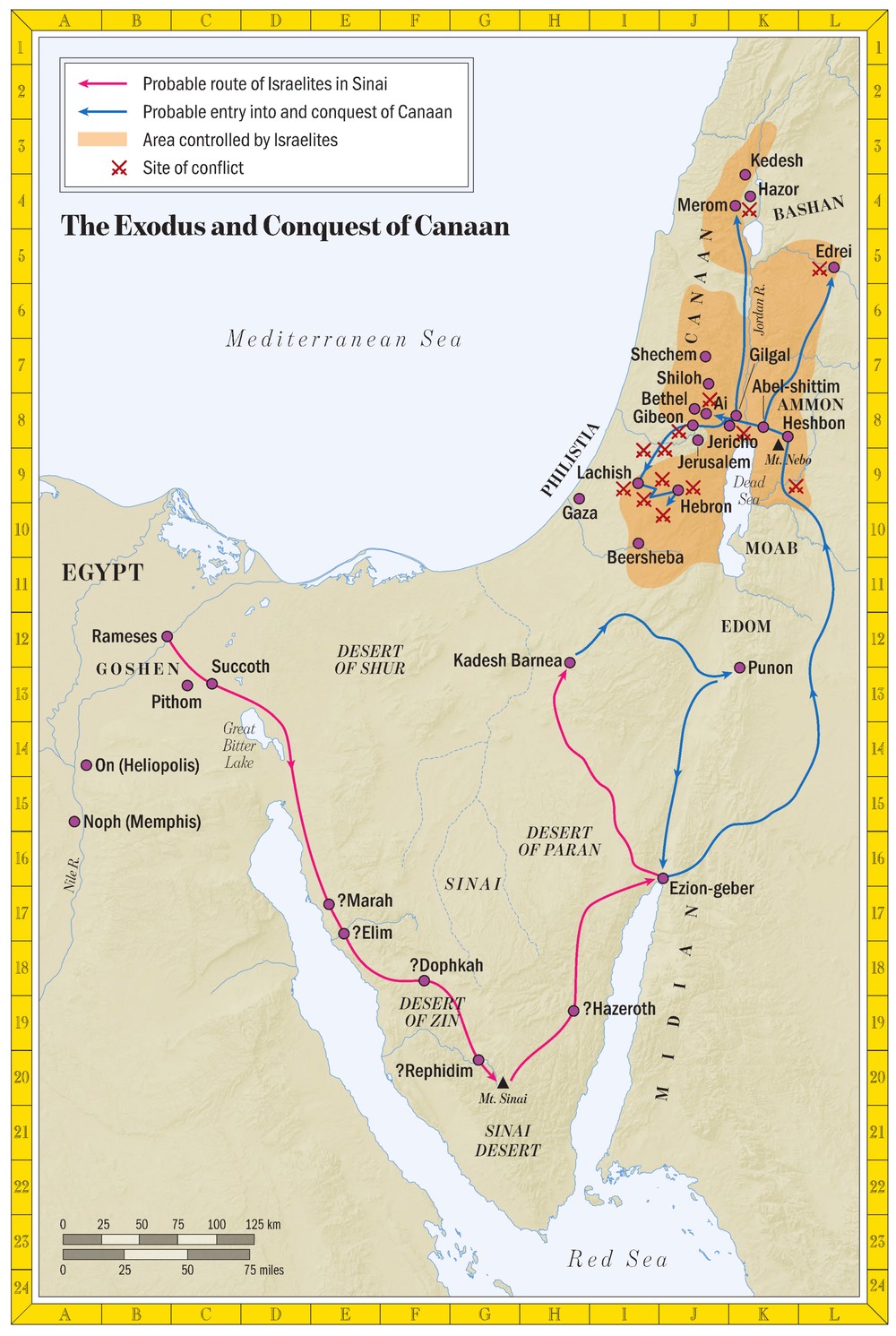
Joshua's strategy was to drive into the center of the land and split it in two, then turn south, and finally north. This map traces Israel's long road out of Egypt, through the wilderness, and into the land, with the sites of conflict marked. Click the map to enlarge it.

Map of the Exodus from Egypt and the conquest of Canaan under Joshua

Map: Biblica, Inc. — “Open Bible Maps,” CC BY-SA 4.0

Central campaign

From the base at Gilgal: Jericho falls (ch 6), then Ai (ch 8), driving a wedge that splits the land. The Gibeonites make peace by trickery (ch 9).

Southern campaign

Five Amorite kings attack Gibeon. Joshua marches all night and routs them as the sun stands still, then takes the southern cities in quick succession (ch 10).

Northern campaign

Jabin of Hazor gathers a coalition with chariots "like the sand on the seashore." Joshua strikes at the Waters of Merom and burns Hazor (ch 11).

III · Going Deeper

Sin is never a private transaction

The Achan story offends modern instincts, and it is meant to. We assume that what a person does behind closed doors is their own affair, but Joshua flatly denies it: one man's hidden greed got thirty-six soldiers killed and stopped a nation in its tracks, and God called it Israel's sin, not just Achan's. We are more connected than we like to admit. The husband's secret, the leader's compromise, the small dishonesty no one sees, these things leak. They cost people who never chose them. This is not a comfortable doctrine, but it is a true one, and it cuts both ways: if your sin can wound the whole body, then your faithfulness, however unseen, can strengthen it. You are not as alone as you feel.

IV · The Hard Question

What do we do with the violence?

An honest study of Joshua cannot tiptoe around its hardest feature: God commands Israel to destroy the Canaanite cities, and many sincere readers find it genuinely troubling. It is right to feel the weight of that rather than explain it away. A few things, held together, let us face it honestly instead of either flinching or pretending it's simple.

It is judgment, not genocide for land's sake. Centuries earlier God had told Abraham his descendants would wait four hundred years to receive the land, because "the iniquity of the Amorites is not yet complete" (Genesis 15:16). God waited four centuries, enduring a culture that practiced ritual prostitution and the burning of children to its gods (Leviticus 18:21–25), before judgment fell. The conquest is presented as a delayed sentence on a specific, deeply violent society, not a license for ethnic cleansing.

It is judicial, not racial. The clearest proof is the people themselves. Rahab the Canaanite throws herself on God's mercy and is saved, grafted into Israel and eventually into the family tree of Jesus. Achan the Israelite takes what is God's and falls under the same judgment as Jericho. The dividing line is never ethnicity; it is response to God. Anyone, from any nation, who turned to Him lived.

The language is partly the rhetoric of its age. Joshua reports cities "utterly destroyed" that are clearly still populated a few chapters later, and Judges opens with Canaanites everywhere. Ancient war accounts routinely used sweeping total-victory language the way we say a team "annihilated" their rivals. Recognizing that convention doesn't dissolve the difficulty, but it does caution us against reading every line with wooden literalism.

Where it finally rests

None of this makes Joshua comfortable, and it should not. What it does is locate the conquest where the Bible locates it: as a sobering, time-bound picture of a holy God's judgment against entrenched evil. And it sets up the deepest answer of all. The same God who judged Canaan would one day take the judgment His own people deserved onto Himself at the cross. The wrath that fell on Jericho is the wrath that fell on Jesus, so that it need never fall on us. A God who does not finally judge evil is not good news to anyone who has suffered it. A God who judged it in His own Son is the gospel.

For Discussion & Reflection

Study questions

Talk it through

  1. Jericho fell to a procession so that the victory could belong only to God. Where are you tempted to fight a battle by your own strength that God means to win His way? Discuss
  2. The book sets Rahab the saved outsider beside Achan the condemned insider. How does that pairing challenge the way we decide who's really "in"? Discuss
  3. Joshua signed the Gibeonite treaty because "they did not ask counsel from the Lord." Where have your prayerless decisions had longer lives than you expected? Discuss
  4. Be honest as a group: how do you sit with the conquest's violence? What helped, and what still aches? Discuss

Reflect quietly

  1. Achan's hidden thing surfaced as someone else's funeral. Is there a "devoted thing" buried under your tent right now, something taken or hidden that you've told yourself is private? Reflect
  2. The wrath that fell on Jericho is the wrath that fell on Jesus in your place. Sit with that this week. What does it change about how you carry your own guilt? Reflect
⚑ Leader Note

The conquest's violence is usually the question your group most wants to raise and is most afraid to. Name it early so it isn't quietly hanging over the whole evening. Aim for honesty over tidy answers: it is fine to say this is hard, to sit in the tension, and to walk slowly to the cross where that judgment lands on Jesus.

Next Week

Week 3 · Dividing the Land; Joshua's Farewell

The long deed of inheritance, the cities of refuge, and an old leader's last, bracing charge: "choose this day whom you will serve." Joshua 13–24.