Moses is dead, and a people who own nothing but a promise stand at the edge of the Jordan. Before a single wall falls, God settles the only question that matters: will they trust the God who keeps His word?
I · The Threshold
More than real estate
Moses is dead. For forty years he had carried this people on his back through the wilderness, and now the man who split the sea and climbed the mountain lies buried in Moab, having seen the land only from a distance. Israel stands at the edge of the Jordan with nothing but a promise, and into that silence God speaks to Moses' young assistant: "Moses my servant is dead. Now therefore arise, go over this Jordan." The wilderness is over. The threshold has come.
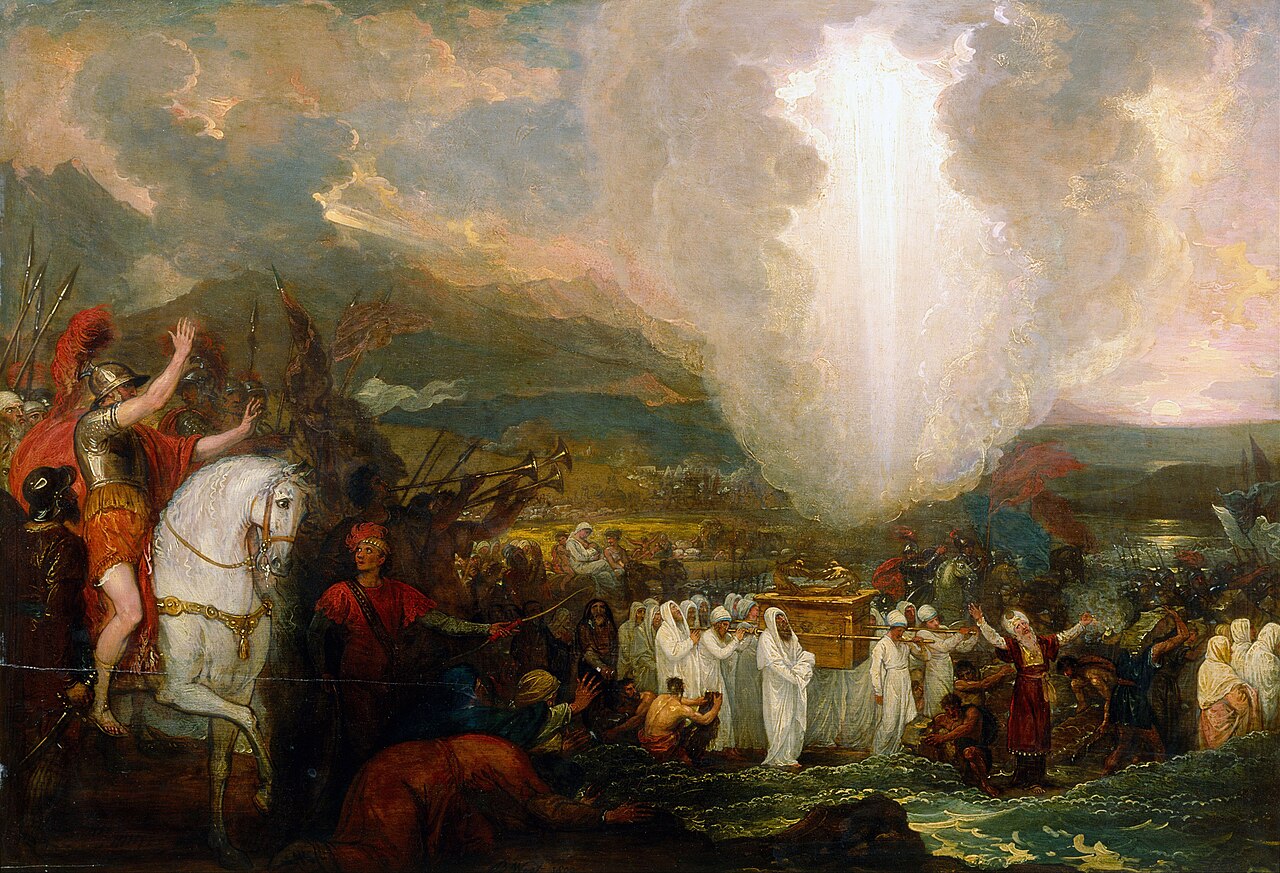
Across on dry ground. Benjamin West, “Joshua Passing the River Jordan with the Ark of the Covenant” (1800). The priests step into the flood and the waters heap up — the Red Sea again, staged so a new generation would have a rescue of its own to remember.
Public domain, via Wikimedia Commons.
It is tempting to read Joshua as a military chronicle, and on the surface it is one. But the book itself keeps pulling your eyes higher, because in the Bible the land was never merely real estate. From the first pages of Genesis, land has meant the place where God dwells with His people in rest and blessing. Eden was such a place, and it was lost. The promise to Abraham of a land was God beginning, in one family and one country, to win back what humanity had thrown away. So when Israel crosses the Jordan, something larger than a border is being crossed. A people is coming home to live with their God in a good land He is giving them.
The whole book will build toward a single sentence that arrives near its end, and it is worth planting now, because it is the thesis of the whole book.
“
Not one word of all the good promises that the Lord had made to the house of Israel had failed; all came to pass.
Joshua 21:45
Strip away the battles and the borders and what remains is a single claim about the character of God: He says what He will do, and then He does it. Joshua was written to a people who needed to believe that, and it has been kept for every people since who have stood at their own Jordan, holding a promise and wondering whether God can be trusted.
Setting
Canaan, c. 1406–1375 BC on the traditional chronology, the generation after the exodus.
This week
Joshua 1–5: the commissioning of Joshua, Rahab and the spies, the crossing of the Jordan, and the commander of the Lord's army.
Big idea
God is faithful to His covenant; His people are called to courageous, wholehearted obedience in response.
Christ in it
Joshua (Hebrew Yehoshua, "the LORD saves") bears the name of Jesus and leads God's people into their inheritance and rest.
II · The Charge
What "be strong and courageous" actually means
Before Israel takes a step, God says one thing to Joshua three times over: be strong and courageous (1:6, 7, 9). We have turned that line into a fridge magnet, a generic shot of confidence. The text means something far more specific, and far more bracing.
Joshua is not told to find courage inside himself. He is told to be courageous for two reasons that have nothing to do with his nerve. The first is a presence: "Just as I was with Moses, so I will be with you. I will not leave you or forsake you" (1:5). The courage God commands is not bravado; it is the calm of a man who knows Who is standing next to him. The second reason is a book:
8This Book of the Law shall not depart from your mouth, but you shall meditate on it day and night, so that you may be careful to do according to all that is written in it. For then you will make your way prosperous, and then you will have good success.
Joshua 1:8
The great conqueror is handed something strange on the eve of war. Not a sword, not a battle plan, but a scroll. Israel's first weapon is Scripture soaked into the mind until it shapes the life. The promised success is not a guarantee of easy victories; it is the deep flourishing of a person whose obedience is fed by constant attention to God's word. Strip that away and "be strong and courageous" becomes empty cheerleading. Keep it, and you have the whole pattern of the faithful life: God's presence in front of you, God's word inside of you, and because of those two things, the freedom to walk toward the giants without flinching.
★ Worth noticing
The same charge runs like a refrain through these books and beyond. David gives it to Solomon (1 Chronicles 22:13). The risen Jesus tells His disciples the deeper version of it: "I am with you always, to the end of the age" (Matthew 28:20). Courage in Scripture is almost never self-generated. It is the natural posture of people who actually believe God is with them.
III · The Crossing, Scene by Scene
Reading Joshua 2–5 with your eyes open
Each scene carries more than action.
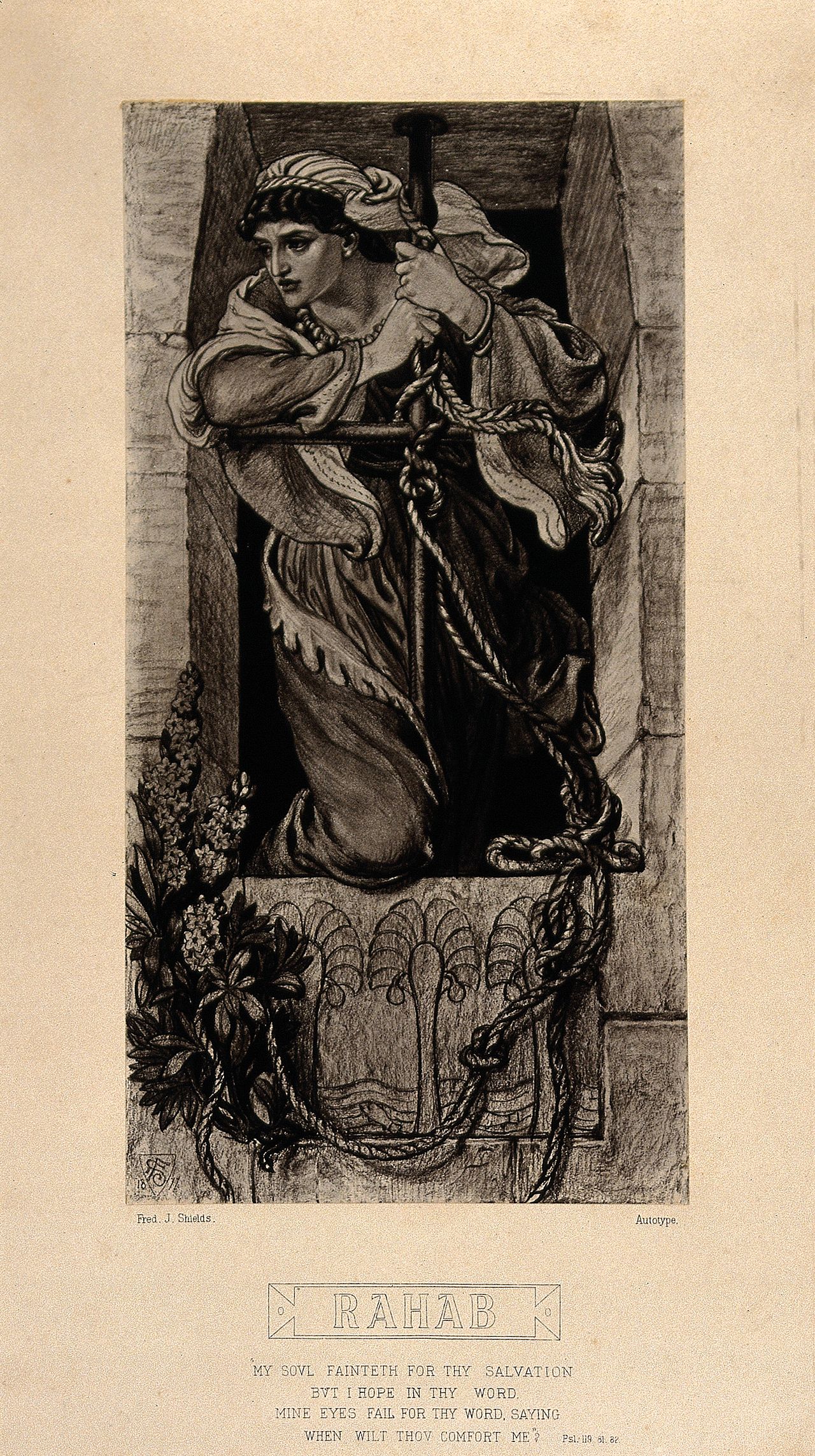
The scarlet cord. Rahab ties the scarlet cord in her window (Joshua 2) — the sign that judgment would pass over her house. A Canaanite of bad reputation is the first in Jericho to throw herself on the mercy of Israel's God.
After a Wellcome Collection plate, CC BY 4.0, via Wikimedia Commons.
Joshua 2
Rahab and the scarlet cord
Before a single battle, the narrative pauses on a Canaanite prostitute. Rahab has heard what God did at the Red Sea and forty years later still trembles at it, while her whole fortified city does not. She hides the spies, confesses that "the Lord your God, he is God in the heavens above and on the earth beneath" (2:11), and hangs a scarlet cord in her window so that judgment will pass over her house. The writer is showing you, on page one, that the conquest is not about bloodline. It is about who will throw themselves on the mercy of the true God, and a foreign woman of bad reputation is the first to do it.
Joshua 3–4
The Jordan stands still
The priests carry the ark into the flooded river, and the moment their feet touch the water, it heaps up and the nation crosses on dry ground. This is staged, deliberately, as the Red Sea all over again: God even says He does it "so that they may know that, as I was with Moses, so I will be with you" (3:7). Most of the people crossing were children or unborn at the exodus. They did not see the sea split. So God gives them their own water, their own dry ground, their own story. Then He commands twelve stones piled at Gilgal for one reason, named twice: "when your children ask… you shall let them know." The crossing is not just a miracle. It is a sermon set in stone, designed to carry faith to a generation that wasn't there.
Joshua 5
The commander with the drawn sword
Outside Jericho, Joshua meets a man with a sword and asks the soldier's question: "Are you for us, or for our adversaries?" The answer reframes everything: "No; but I am the commander of the army of the Lord." God has not come to take sides in Joshua's war. Joshua has been summoned into God's. The general of Israel takes off his sandals on holy ground, and we are reminded who is actually leading this campaign. It was never Joshua.
Going Deeper · Circumcision and Passover at Gilgal
Before any fighting, God has the new generation do two quiet things at Gilgal: they are circumcised, taking on the covenant sign their wilderness years had let lapse, and they keep the Passover. Only then does the manna stop and they eat the produce of the land (5:10–12). The order matters. Before Israel lifts a sword, God re-establishes them as His covenant people and feeds them at His table. Identity and worship come first; the battle comes second. It is a pattern worth carrying: we do not fight our way into belonging to God. We fight from it.
People to Know
Two lives at the threshold
❖
Joshua
Successor of Moses
TribeEphraim
Name means"The LORD saves"
Defining actLed the conquest
Lived110 years
"Be strong and courageous."Joshua 1:9
One of only two spies who trusted God forty years earlier. Lesson: courage is not the absence of fear but obedience that keeps walking while afraid, anchored to God's presence and word.
Rahab
The Canaanite who believed
FromJericho
Known asA prostitute
SignThe scarlet cord
LegacyIn Jesus' line
"The LORD your God, he is God in the heavens above and on the earth beneath."Joshua 2:11
She risked her life on a God she had only heard about. Lesson: grace reaches the least likely first. Rahab lands in Hebrews 11, James 2, and the genealogy of Christ (Matthew 1:5).
IV · Christ at the Crossing
A scarlet cord and a river
Two images from this week reach forward to the gospel. The first is Rahab's scarlet cord, hung in a window so that the household inside would be spared when judgment swept through the city. It is the logic of the Passover lamb, and it points on to a greater blood that marks out those who belong to God and turns judgment aside. The first person saved in the promised land is a Gentile woman of bad reputation who trusted a sign of blood, and the New Testament will not let us forget it.
The second is the river itself. God's people pass through the waters on dry ground and come up on the far side into their inheritance, led by a man whose name, Yehoshua, is the very name that comes into Greek as Jesus. It is hard to miss what the writer is sketching. There is a greater Joshua who leads His people through the waters of death and into a land that will not be lost, and it is His name this one has been carrying all along.
For Discussion & Reflection
Study questions
Talk it through
God roots Joshua's courage in His presence and His word, not in Joshua's nerve. Where are you currently trying to manufacture courage instead of drawing it from those two wells? Discuss
Israel piled up stones so that one day their children would ask, "What do these mean?" What are the "stones" in your life or church, and are they prompting the questions they were meant to? Discuss
The commander of the Lord's army answered Joshua's "for us or for them?" with a flat "No." Where are you tempted to ask God to join your plans rather than asking to be enlisted in His? Discuss
Rahab believed a God she had only heard about, while her whole city, with the same reports, did not. What do you make of the difference? Discuss
Reflect quietly
God re-established Israel's identity and worship at Gilgal before a single battle. Where are you trying to fight your way into belonging instead of fighting from it? Reflect
What is the Jordan you are standing at right now, holding a promise and waiting to see whether God will keep it? What would it look like to step in? Reflect
Next Week
Week 2 · Jericho, Achan & the Campaigns
The walls fall to a procession, a hidden sin costs a nation, and Joshua drives through the land as the sun stands still. Joshua 6–12.