I · Coming Home
A kingdom knit back together
Absalom is dead, and David makes the long, painful journey back to Jerusalem, gathering the loyalties of a divided people as he goes. There are still fault lines, a fresh revolt under a man named Sheba, old resentments between north and south, the seeds of the split that will one day tear the kingdom in two. But for now the throne is restored, and the king who rose with clean hands and fell so hard is carried back to his place, not because he deserved it, but because God's promise did not depend on David's record. Grace ran under the wreckage the whole time, and now it carries him home.
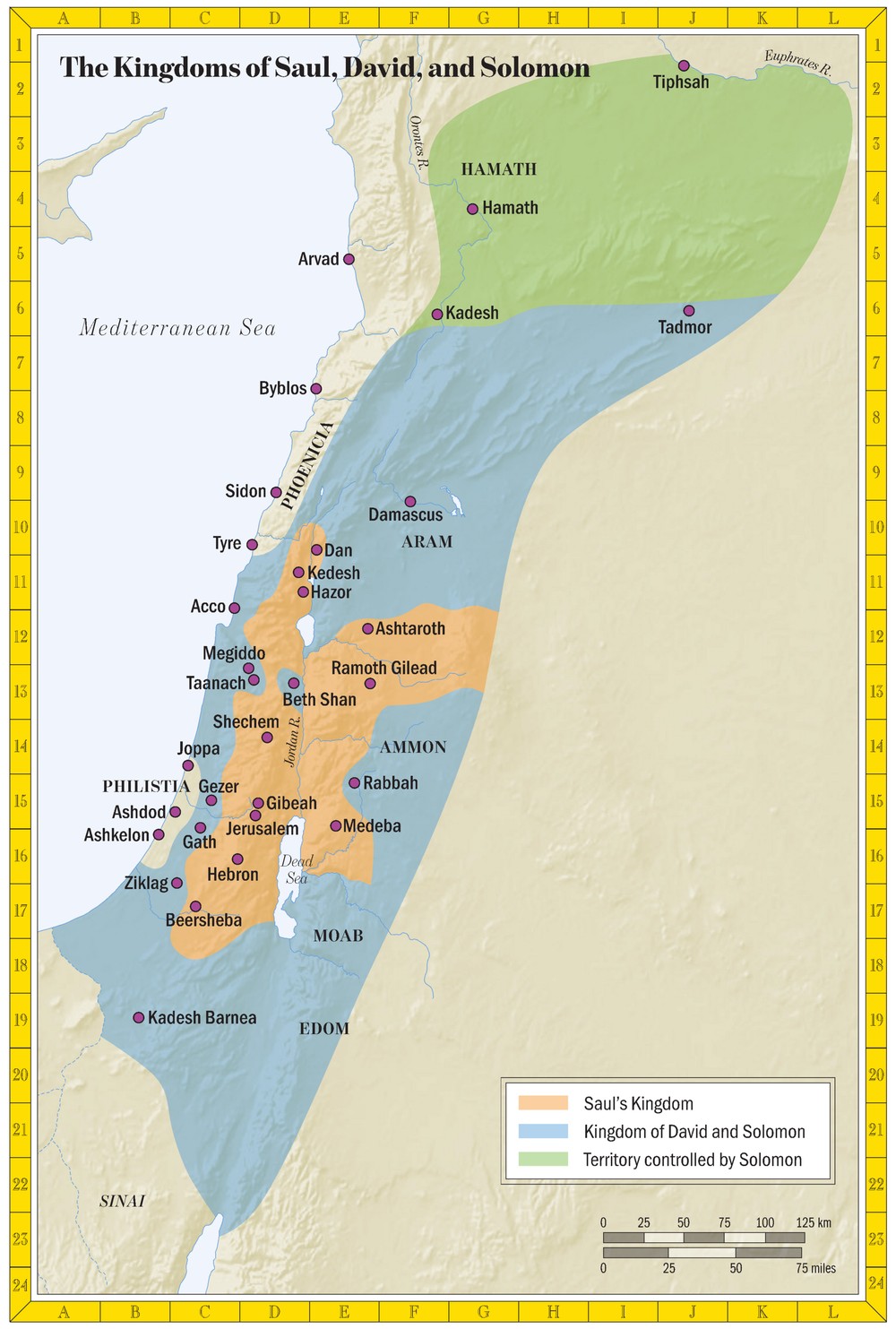
Map: Biblica, Inc. — “Open Bible Maps,” CC BY-SA 4.0
II · Chapters 22–23
The last songs of a shepherd king
The final chapters are not narrative but reflection, a kind of scrapbook the book gathers before it closes. There is David's great song of deliverance (chapter 22, nearly identical to Psalm 18), the boy with the harp still singing at the end of a long, hard life, still calling God his rock and his fortress and the one who "brought me out into a broad place; he rescued me, because he delighted in me." There are his last words, naming the kind of ruler the world actually needs: "one who rules justly over men, ruling in the fear of God" (23:3), a description that outran David himself and waited for a better King. And there is the roll of his mighty men, the loyal, unglamorous warriors who stood with him through the wilderness years, remembered here by name, because faithfulness like theirs does not go unrecorded in heaven.
III · Chapter 24
An altar on the threshing floor
The book ends on a strange, fitting note. David sins again, taking a census out of pride, and a plague follows. To stop it, David is told to build an altar on the threshing floor of a man named Araunah. When Araunah offers to give the ground and the oxen for free, David refuses with a line that gathers up everything the book has taught about worship:
He pays the full price, builds the altar, and the plague is stopped. And the location is no accident. That threshing floor is the very ground where David's son Solomon would build the temple, the house David longed to build and was not allowed to. The story that opened with a borrowed tent on the wrong side of the Jordan now ends with an altar on the hill where God's house would stand, purchased at cost, on a spot marked by both judgment and mercy. Everything in the book has been reaching toward a place where God dwells with His people and a King who rules in the fear of God. Neither has fully arrived. David dies, the throne passes on, and the great word of chapter 7 still hangs in the air: forever.
For Discussion & Reflection
Study questions
Talk it through
- David was carried back to his throne not because he deserved it but because God's promise held. Where do you need to trust a promise of God that does not depend on your record? Discuss
- David's last words describe a ruler "who rules justly… in the fear of God," a standard he never fully met himself. Why does the Bible keep raising a bar its heroes cannot clear? Discuss
- "I will not offer to the Lord that which costs me nothing." What would costly worship look like for you, as opposed to convenient worship? Discuss
- The book ends with an altar on the ground where the temple would rise, everything still pointing forward. How does an unfinished ending prepare you for the King who fills it? Discuss
Reflect quietly
- David's mighty men are remembered by name for their quiet, faithful loyalty. Where is your unglamorous faithfulness being recorded, even if no one on earth is watching? Reflect
- The old shepherd was still singing at the end, still calling God his rock. What song do you want to be singing at the end of a long, hard life? Reflect
The Final Week
Week 16 · David's Throne and the Manger
The whole road, from a borrowed tent to a throne that has no end. The King the ache of Judges longed for, the Redeemer Ruth sketched, the heart 1 Samuel searched for, the Son of David the covenant promised, born at last in Bethlehem.