Home/The Weeks/Week 13

Movement V · 2 Samuel · Week 13 · 2 Samuel 7–10

The Davidic Covenant; Mephibosheth

David wants to build God a house. God answers with a holy reversal: no, I will build you a house, a throne that will never end. And then David, at the height of his power, seats a crippled heir of his enemy at his own table.

I · The Center of the Book

The Davidic Covenant

Settled at last in a palace of cedar, David is troubled that he lives in a fine house while the ark of God still sits in a tent. He decides to build God a house, a temple, and it is a genuinely good impulse. But through the prophet Nathan, God answers with a holy reversal, and it hinges on a single word. The Hebrew word for "house" can mean a building or a dynasty. David says, in effect, "I will build You a house." God replies, "No. I will build you a house." Not a house of stone, but a line, a dynasty, a kingdom that will never end.

16And your house and your kingdom shall be made sure forever before me. Your throne shall be established forever. 2 Samuel 7:16

This is one of the high points of the whole Bible. Remember the ache Judges built up for a king. Remember the name David that Ruth quietly delivered in its final verse. Remember the search in 1 Samuel for a man after God's own heart. Now God binds Himself, by sworn promise, to David's house, with pledges that no later failure could ever cancel:

A great name

God will make David's name great and plant Israel in a secure home (7:9–10). The reputation David could not build for himself, God gives.

An offspring

God will raise up David's offspring after him and establish his kingdom (7:12). Solomon fulfills this in part; Someone greater fulfills it forever.

A father-son bond

"I will be to him a father, and he shall be to me a son" (7:14). When he sins, God will discipline him, "but my steadfast love will not depart from him." This is grace, not merit.

An everlasting throne

The throne is established "forever" (7:16). No human reign lasts forever, so the promise quietly reaches beyond David toward a King who will not die.

David's son Solomon would build the temple and inherit the kingdom, fulfilling part of this. But "forever" is a word no human king can carry, and David seems to sense it. His response is not pride but stunned worship: "Who am I, O Lord God, and what is my house, that you have brought me thus far?" (7:18). From this moment the promise of an eternal Davidic throne hangs over the rest of the Old Testament like a fixed star. Every prophet who later speaks of a coming Branch from David's line is reading by its light, waiting for the Son who would finally fill it.
II · Going Deeper

Mephibosheth, and the gospel in one scene

It is easy to read past the Mephibosheth story (chapter 9) as a pleasant interlude between the wars. But it may be the clearest picture of the gospel in the Old Testament, hiding in plain sight.

Here is a man from a condemned house, the dynasty God had rejected. He is the grandson of David's great enemy, the kind of person a new king would normally execute to secure his throne. He is crippled in both feet, unable to come to the king under his own power, and he is hiding in a place whose name, Lo-debar, means roughly "no pasture," a nowhere of shame and fear. David seeks him out, not the other way around. David restores to him everything his family had lost. And then David does the thing that turns a kindness into a portrait of grace: he seats this broken, undeserving man at the royal table, "like one of the king's sons," for the rest of his life. Mephibosheth can only stammer, "What is your servant, that you should show regard for a dead dog such as I?"

So Mephibosheth ate at David's table, like one of the king's sons.

2 Samuel 9:11

That is your story, if you belong to Christ. You were of a condemned house, unable to come to the King under your own power, hiding in a place with no pasture. And the King sought you out, restored what was lost, covered your crippled feet under His own table, and gave you a permanent seat among the sons. We did not climb up to grace. Grace came down to Lo-debar and called us home by name.

The United Kingdom

David's kingdom

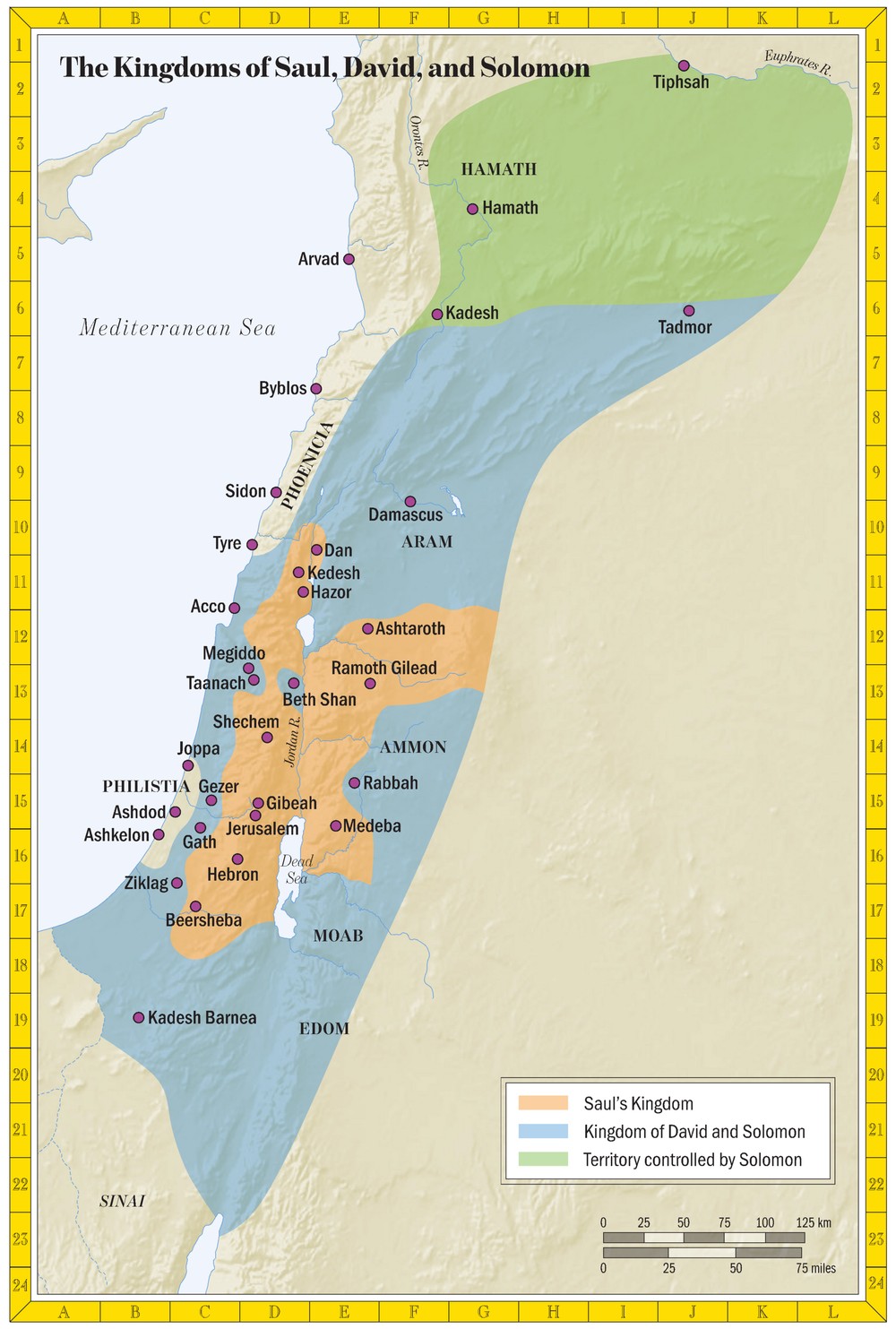
With the covenant given and his enemies subdued (chapters 8–10), David extended Israel's reach over the surrounding nations, securing at last the borders God had promised Abraham. On the map, David's kingdom is shaded blue, with Solomon's later sphere in green. Click the map to enlarge it.

Map of the united kingdom of David, expanded far beyond Saul's, over the surrounding nations

Map: Biblica, Inc. — “Open Bible Maps,” CC BY-SA 4.0

David's kingdom (blue) reached far beyond Saul's (orange), subduing Philistia, Moab, Ammon, Edom, and Aram. Solomon's wider sphere is shown in green.

People to Know

The prophet and the guest at the table

Nathan
The faithful prophet
  • RoleCourt prophet
  • DeliveredThe covenant
  • Later"You are the man"
  • Marked byCourage

"The LORD declares to you that the LORD will make you a house."2 Samuel 7:11

Lesson: A true friend brings the king both the promise and, later, the rebuke. Nathan carried God's word without flinching either way.

Mephibosheth
Grace at the table
  • FatherJonathan
  • Of the house ofSaul
  • ConditionLame in both feet
  • GivenA seat as a son

"What is your servant, that you should show regard for a dead dog such as I?"2 Samuel 9:8

Lesson: He brought nothing and deserved nothing, and the king sought him out and seated him as a son. That is grace, and that is us.

For Discussion & Reflection

Study questions

Talk it through

  1. David wanted to build God a house; God said He would build David one. Where do we offer God our plans when He wants to give us His promise instead? Discuss
  2. The covenant promised an everlasting throne, a word no human king could carry. How does that "forever" quietly point beyond David? Discuss
  3. Walk through the Mephibosheth story as a picture of the gospel. Which detail lands hardest for you? Discuss
  4. David used his power to seek out and honor a man with every reason to fear him. How might God be calling you to use your position for someone the world overlooks? Discuss

Reflect quietly

  1. You were in Lo-debar, a place with no pasture, and the King came looking for you. Sit with the fact that you eat at His table as a son, not a servant. Reflect
  2. David's stunned "Who am I?" is the right response to grace. When did you last feel that astonishment at what God has given you? Reflect

Next Week

Week 14 · Bathsheba, Nathan & the House Divided

A rooftop on a spring evening, a prophet's "you are the man," and the long shadow one night casts over a family and a kingdom. 2 Samuel 11–18.