Home/The Weeks/Week 11

Movement IV · 1 Samuel · Week 11 · 1 Samuel 17–31

David & Goliath to Saul's End

A shepherd runs toward a giant no soldier will face, and the whole story turns out to be about more than courage. Then come the jealousy, the friendship that gave everything away, the wilderness years, and a throne David would not take by force.

I · The Valley of Elah

More than a story about being brave

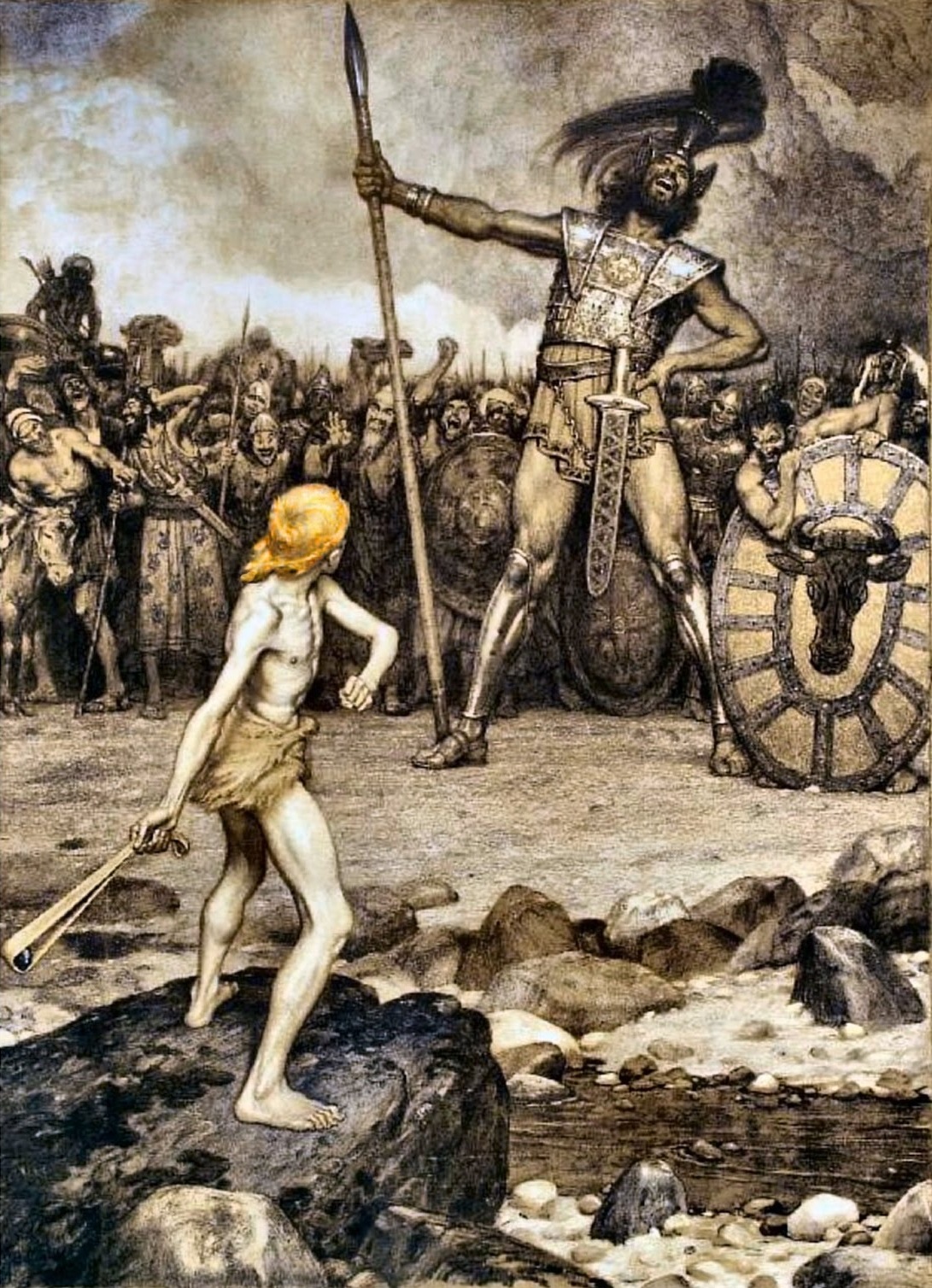
We have shrunk David and Goliath into a children's story about facing your fears, and missed what the chapter is shouting. In the Valley of Elah, a nine-foot Philistine champion taunts the armies of Israel for forty days while grown soldiers tremble. A shepherd boy delivering bread to his brothers hears the blasphemy and is offended that no one will answer it. Refusing armor, he takes five smooth stones and runs toward the giant, shouting that "the battle is the Lord's" (17:47). One stone, and the giant falls. Look at the shape of it: a people who cannot save themselves, paralyzed by an enemy they cannot beat, rescued by an unlikely champion who fights in their place and wins the victory they then get to share. That is the pattern this week keeps tracing, all the way to the throne.

Osmar Schindler's painting of the boy David winding up his sling to face the towering armored Goliath.
“The battle is the Lord's.” Osmar Schindler, “David and Goliath” (c. 1888). A shepherd boy runs toward the giant with five smooth stones — a people who cannot save themselves, rescued by an unlikely champion who fights in their place. Public domain, via Wikimedia Commons.

II · Walking Through the Story

The rise of David and the fall of Saul

1 Samuel 17

David and Goliath

A shepherd boy hears a giant blaspheme the armies of the living God and is offended that no one will answer. Refusing Saul's armor, he takes five smooth stones and runs toward the champion, shouting that "the battle is the Lord's." One stone, and the giant falls. The right response to Goliath is not first "go be brave." It is "look at the Champion who fights for a people who cannot fight for themselves."

1 Samuel 18–20

Jealousy, and a friendship that gave everything away

The women sing that Saul has struck down thousands and David tens of thousands, and from that day Saul watches David with a suspicion that curdles into murderous rage, hurling a spear at him more than once. Against that hatred shines one of the Bible's great friendships. Jonathan, Saul's own son and rightful heir, loves David "as his own soul" and binds himself to him by covenant, knowing full well that David's rise means his own throne is gone. He gives it up gladly. It is a rare kind of love: the kind that lets go of its own claim for the sake of God's chosen one.

1 Samuel 21–26

David the fugitive, and the throne he wouldn't grab

David spends years on the run, hunted across the wilderness, gathering a band of the desperate and the indebted at the cave of Adullam. Twice Saul falls completely into his hands, once in a cave at En-gedi and once asleep in his own camp, and twice David refuses to lift a finger against "the Lord's anointed," choosing to wait for God's timing rather than seize the crown by force. He already has the anointing; he will not take the throne by murder. It is the discipline that defines him: a man who trusts God enough to wait.

1 Samuel 28, 31

Saul's last night, and last day

On the eve of his final battle, abandoned by the God he stopped obeying, Saul does the very thing he once outlawed and consults a medium at Endor to summon Samuel, who only confirms his doom. The next day, on the slopes of Mount Gilboa, the Philistines overwhelm Israel. Jonathan is killed, and Saul, gravely wounded, falls on his own sword. The first king's story ends in the dark, by his own hand, while the man already anointed waits in exile for a throne he would not take by blood.

III · Going Deeper

Two things this week is really teaching

A champion who fights in your place

Israel cannot win the fight in the valley; the whole army is helpless before a single overwhelming enemy. So one chosen representative goes out alone, in the name of the Lord, defeats the enemy his people could never beat, and wins a victory they then share simply by belonging to him. That is not first a lesson about your courage. It is a picture of your Savior. Where you stand frozen before sin and death, a greater Son of David went out alone, in your place, and won. The right response to Goliath is not "go be brave." It is "look at the Champion who already fought for you."

The hardest faith is the faith that waits

David is anointed king in chapter 16 and does not actually sit on the throne until the next book, years and years later, after running for his life through caves and wilderness. Twice he could have ended it all with one thrust of a spear into a sleeping Saul, and twice he refused, because the throne taken by murder would not be the throne given by God. There is a particular kind of faith on display there, and it is rarer than the storming-the-giant kind. It is the faith that already has the promise and still waits, that refuses to grab with its own hand what God has said He will give in His own time. Most of us find Goliath easier than the cave. The cave is where David was made.

The World of Samuel and Saul

Where it all happened

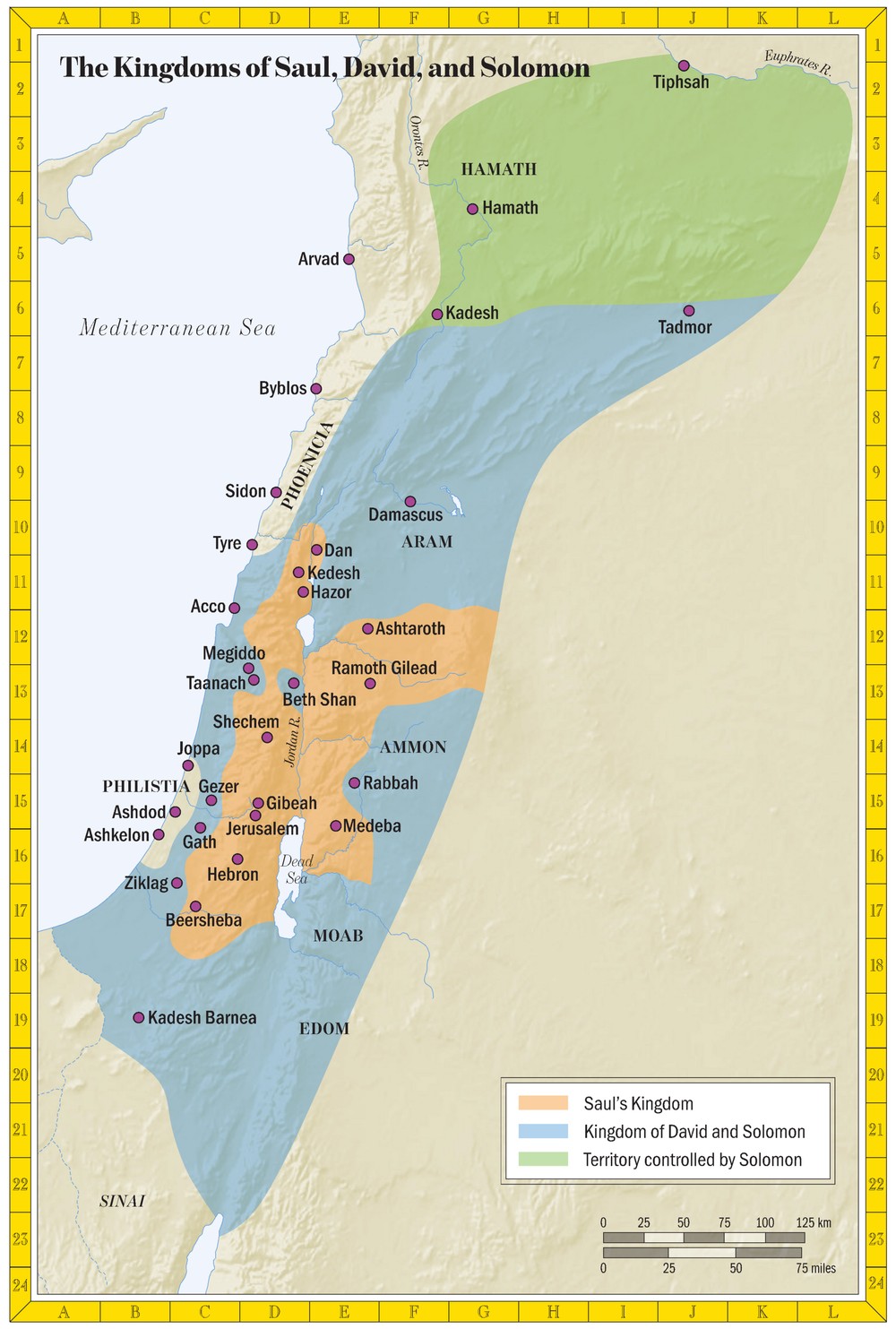
From Samuel's home at Ramah to the fatal slopes of Gilboa, the story plays out across a small, crowded landscape. The map shows Saul's kingdom (shaded orange); the table locates the key events. Click the map to enlarge it.

Map of the kingdom of Saul, later expanded under David and Solomon

Map: Biblica, Inc. — “Open Bible Maps,” CC BY-SA 4.0

Saul's kingdom is shaded orange. It would expand greatly under David and Solomon (blue and green) in the next book.
The key places in 1 Samuel.
PlaceWhat happened there
BethlehemDavid anointed by Samuel (ch 16).
Valley of ElahDavid defeats Goliath (ch 17).
GibeahSaul's hometown and royal capital.
En-gediDavid spares Saul's life in the cave (ch 24).
ZiklagDavid's base in Philistine territory.
EndorSaul consults a medium on his last desperate night (ch 28).
Mount GilboaSaul and Jonathan fall in their final battle (ch 31).

People to Know

The friend who let go of a throne

Jonathan
The selfless friend
  • FatherKing Saul
  • WasThe heir
  • ChoseTo protect David
  • BondCovenant friendship

"He loved him as he loved his own soul."1 Samuel 18:1

Lesson: Jonathan surrendered his own claim to the throne for the friend God had chosen. The truest love lets go of rivalry.

For Discussion & Reflection

Study questions

Talk it through

  1. David and Goliath is usually taught as "face your giants." How does reading it as a picture of a champion who fights in your place change the point? Discuss
  2. Jonathan gladly gave up his own claim to the throne for God's chosen one. Where is God asking you to let go of a rivalry or a claim for someone else's sake? Discuss
  3. David already had the anointing but waited years for the throne, twice refusing to take it by force. How do you tell the difference between faith that waits and passivity that won't act? Discuss
  4. Saul ended by consulting a medium, doing the very thing he once outlawed. How does abandoning God slowly reshape what a person is willing to do? Discuss

Reflect quietly

  1. Most of us find Goliath easier than the cave. Where in your life is God asking you to wait for something He has promised rather than grab it yourself? Reflect
  2. Look at the Champion who already fought for you where you stood frozen. What does it free you from to know the victory is already won? Reflect
⚑ Leader Note

It is tempting to make Saul a cartoon villain and David a flawless hero, and 1 Samuel resists both. Saul started humble and genuinely gifted; David's worst chapters are still ahead of him in 2 Samuel. Keep the group's focus on the heart, not the highlight reel, and let David and Goliath preach the gospel rather than a self-help sermon.

Next Week

Week 12 · King in Jerusalem & the Ark

The crown is finally David's. A united kingdom, a new capital, and the ark of God brought home with dancing. 2 Samuel 1–6.